This is a very accurate, quality made replica of the noseconecone mounted on the famous McLaren MP4/6.
This piece will be the centrepiece for any Senna collector. It is provided with a stand.
1989 Ayrton Senna personal McLaren shirt signed
Regular price
This is Ayrton Senna personal McLaren Tshirt used during the 1989 season.
It has been hand signed and dated in black market by Ayrton Senna.
1993 Ayrton Senna Sabelts signed and dated
Regular price
Very rare and desirable: Ayrton Senna Sabelts protections.
Hand signed and dated in black marker by the legend himself.
1987 Ayrton Senna Lotus 99T full rear wing
Regular price
You want exceptional? We are giving you exceptional:
1987 Lotus 99T full rear wing. Race used by Ayrton Senna during the 1987 season.
It bares the Camel and ELF logos. Just received, not yet cleaned up.
Ayrton Senna's 1987 Formula 1 season showed how talented Senna was. He won two races, the Monaco Grand Prix and Detroit Grand Prix, and finished third in the Drivers' Championship, behind Nelson Piquet and Nigel Mansell. Senna started the season strongly, winning the Monaco Grand Prix for the first time in his career.
Expensive...
1987 Ayrton Senna Lotus 99T rear O.Z. Racing rim
Regular price
This OZ racing rear wheel from Ayrton Senna's Lotus 99T is a remarkable piece of Formula 1 history. Bearing the markings of "Lotus 2-88," it is a significant artifact from the 1987 season, a period when Senna was establishing his legacy in the sport. The wheel's worn condition reflects the intense competition and rigorous demands of racing at the highest level. As a part of the iconic Lotus 99T, this wheel is a valuable collector's item, symbolizing Senna's relentless drive and the technological advancements of that era in Formula 1.
1985 Ayrton Senna Lotus 97T rear wing end plates
Regular price
These 2 plates were mounted on the Lotus 97T rear wing driven by Ayrton Senna during the 1985 Portuguese GP. Can be sold separately. The GoodYear logo as all pars of this era is not a sticker but hand painted.
They are incredible pieces of F1 history.
1985 Ayrton Senna Lotus 97T left front wing end plate
Regular price
This front wing end plate from Ayrton Senna's Lotus 97T is a valuable artifact from his 1985 Formula 1 season. Featuring the iconic John Player Special (JPS) logo, it is a symbol of the era's distinctive branding and Senna's early successes in F1. As an original component from one of Senna's most famous cars, this end plate represents the engineering excellence and competitive spirit that marked his career. For collectors and fans, it serves as a tangible connection to Senna's legendary achievements on the track.
1987 Ayrton Senna Lotus 99T FWEP skirts pair
Regular price
These front wing end plates, or skirts, from Ayrton Senna's Lotus 99T are a rare and significant piece of Formula 1 history. Used during the 1987 season, these carbon fiber components bear the marks of intense use and are labeled "TYPE 99." They represent the innovative engineering and precision that characterized Senna's driving and Lotus's approach during this era. As a part of the car that Senna piloted to multiple victories, these end plates are a remarkable collector's item, embodying the legacy of one of the sport's greatest drivers.
1987 Ayrton Senna Stand 21 race used gloves signed
Regular price
A pair of Ayrton Senna Stand 21 race gloves, worn during the 1987 Formula 1 season. Both gloves are hand-signed and dated by Senna and his teammate, Satoru Nakajima, from the Lotus team.
They show heavy signs of use.
1987 Ayrton Senna Monaco GP signed race used shoes
Regular price
We are extremely pleased to present the following exceptional items: a pair of Adidas shoes worn by Ayrton Senna during the prestigious 1987 Monaco Grand Prix. This race marked Senna's fifth victory in Formula 1. These shoes are one of only three pairs of black shoes made for Senna during his time with Lotus. Each shoe is hand-signed and dated in white marker, with "A. Senna" inscribed inside, along with the manuscript date of 31/5/1987, commemorating the race date.
The shoes exhibit significant signs of use and are accompanied by an official Lotus certificate.
Expensive...
Summary of the race:
The Monte Carlo street circuit has always been a challenge for Formula 1 drivers. For 37 years, no Brazilian had won there. Ayrton Senna came close in 1984 but wanted to celebrate a victory. In 1987, Senna faced more challenges. He retired from two out of three races (Brazil and Belgium) and finished second in San Marino. Lotus had a new, untested active suspension system that could help on Monaco's bumpy track, but it shook the team's confidence. During qualifying, Senna secured second on the grid. Nigel Mansell took pole position, followed by Nelson Piquet and Alain Prost. Michele Alboreto and Eddie Cheever were in the third row. A controversy arose as FISA allowed 26 cars to race, potentially causing a traffic jam in the narrow streets. Usually, the six slowest cars in qualifying didn't race, with only 20 cars competing. But to appease sponsors, all 26 cars started that day. Notably, the front row was a repeat of the previous race where Senna and Mansell had crashed in Belgium. Senna assured the press it wouldn't be a problem, despite the risks. On race day, Mansell kept the lead initially, but on lap 29, his turbocharger failed, forcing him to retire. Senna then took the lead and dominated the race, eventually finishing 33 seconds ahead of Nelson Piquet. Michele Alboreto finished third. Senna's victory marked the first time a Brazilian had won at Monaco, cementing his status as one of Brazil's greatest sports figures. After the checkered flag, Senna relaxed by thanking each team mechanic over the Lotus radio. He explained, "When I couldn't keep up with Mansell, I saved my tires and brakes for the second half. After Mansell retired, I focused on avoiding backmarkers and maintaining concentration." During the celebration, Senna joyfully showered Prince Rainier of Monaco with champagne. Senna would go on to win at Monaco five more times in his career. Afterward, he was invited by the Prince to the Royal Family dinner. This win marked Senna's fifth in Formula One and the first by a car using active suspension. The standings were Prost with 18 points, Senna 15, Johansson 13, Piquet 12, and Mansell 10.
1984 Ayrton Senna Stand 21 used gloves signed
Regular price
Stand 21 gloves used by Ayrton Senna during the 1984 season.
Both gloves have been hand-signed and dated using a black ink marker and possess considerable significance. Notably, 1984 marked the debut of Senna in Formula 1, a year that would become a pivotal cornerstone in the history of F1.
Both gloves exhibit significant signs of wear.
In 1984, Ayrton Senna made his inaugural appearance in the highly competitive world of motorsport’s premier category, Formula 1. Taking the wheel for the small team Toleman, Senna embarked on his Formula 1 journey, an expedition that would eventually lead him to remarkable achievements.
The captivating tale of Senna’s Monaco reign commenced in 1984, marked by an awe-inspiring performance during a rain-soaked race. There, he conquered his first podium finish in Formula 1, securing the second position behind Alain Prost’s McLaren.
1993 Ayrton Senna OMP used balaclava signed
Regular price
An extraordinary and historically significant piece of Formula 1 memorabilia — this original OMP fireproof balaclava was worn by Ayrton Senna during the 1993 Brazilian Grand Prix, held on March 28th, 1993 at Interlagos. That weekend, Senna delivered one of his most iconic performances, securing pole position in front of his home crowd while driving for McLaren-Ford, marking a defining moment in his career and legacy.
The balaclava features the OMP manufacturer’s embroidered tag at the base, confirming its authenticity as professional-grade racing gear used during that era. Inside the lower edge is a factory-applied label reading “A. SENNA” in red lettering, matching the specification used by McLaren team equipment during the 1993 season.
Most notably, the balaclava has been personally hand-signed and dated by Ayrton Senna in blue ink on the front. The signature was applied the same day at Interlagos, immediately following qualifying, making this a race-used, pole position–signed artifact — an exceptionally rare convergence of provenance and historical importance.
Details:
Driver: Ayrton Senna
Team: McLaren-Ford
Grand Prix: Brazilian GP, Interlagos, March 28, 1993
Result: Pole Position (1st on grid)
Manufacturer: OMP
Type: FIA-approved fire-resistant racing balaclava
Features: Embroidered OMP logo patch, internal “A. SENNA” name tag, visible race wear from use
Autograph: Hand-signed and dated by Ayrton Senna in blue marker
Condition: Excellent display condition with light race wear; signature remains clean and legible
The presence of the internal “A. SENNA” tag and authentic OMP patch corroborate its original race-issue status. The autograph, dated from the same day, further authenticates its historical value.
Notes: A museum-grade collectible from one of the most revered figures in motorsport history. This signed, race-used balaclava captures the essence of Senna’s final years in Formula 1 and his deep bond with Brazil. An extremely rare opportunity for collectors and institutions to acquire a pole position–worn and signed artifact from the greatest driver of his generation.
1991 Ayrton Senna McLaren MP4/6 Brake disk signed
Regular price
Here is an extremely rare piece of memorabilia.This disk brake has been used by Ayrton Senna during the 1991 season which has been his third world Champion title.
It comes from the legendary McLaren MP4/6
It is hand signed and dated by Ayrton Senna.
This extraordinary piece is accompanied by a McLaren certificate.
1987 Lotus 99T front wing as driven by Ayrton Senna
Regular price
This is the front right wing of the 1987 Lotus 99T driven by Ayrton Senna. Most of the front side wings during the 1987 season were wider. This one is similar to the front side wings used during the Belgium GP (SPA).
Extremely rare and desirable. Accompanied with a certificate from "Classic Team Lotus"
Ayrton Senna Stand 21 Race Gloves Winter Testing, Imola 1986
Signed and Inscribed “Imola” in blue ink Provenance: Stand 21 Racewear, Dijon, France
A pair of original Stand 21 race gloves worn by Ayrton Senna during pre-season testing at Imola in 1986, representing one of the earliest artifacts from the Brazilian legend’s formative years in Formula 1.
Constructed in blue Nomex and tan leather, these gloves were produced by Stand 21, the French manufacturer renowned for outfitting elite drivers with FIA-approved safety gear. Both gloves are hand-signed and dated by Senna, who also inscribed the name “Imola”, marking the exact location of their use.
Accompanying the pair is an exceptionally rare original Stand 21 factory wrap, which explicitly identifies the gloves as “Ayrton Senna winter test Imola 1986”. This label confirms their provenance directly from the supplier responsible for Senna’s racewear at the time, adding an extraordinary level of authenticity.
These gloves are presented framed with a period photograph of Senna donning similar blue gloves and his iconic yellow “Nacional” helmet, capturing the intensity and focus that defined his early racing years with Team Lotus.
Items directly tied to Senna’s 1986 testing period—when he fine-tuned the legendary Lotus 98T—are exceptionally scarce, and few possess such impeccable provenance.
Description:
Original Stand 21 gloves used by Ayrton Senna, Imola winter test 1986
Signed and inscribed “Imola” by Senna in blue ink
Retains original Stand 21 factory wrap marked “Ayrton Senna winter test Imola 1986”
Presented framed with a period photo
In excellent, well-preserved condition
Dimensions (framed): Approx. 45 x 35 cm Estimate: USD 25,000 – 40,000 Offered with Certificate of Authenticity
A museum-grade artifact of Ayrton Senna’s early Formula 1 career, encapsulating the passion, precision, and spirit of one of motorsport’s greatest icons.
1994 Ayrton Senna OMP used balaclava signed
Regular price
This original race OMP balaclava has been used by Ayrton Senna during the qualifying in Imola on April 30th, 1994. 1 day before his tragic death.
It has been hand signed and dated by Senna the same day.
This piece has an historical and tragic significance.
Accompanied by our certificate.
Ayrton Senna and the weekend of April 1994
“And so you touch this limit, something happens and you suddenly can go a little bit further. With your mind power, your determination, your instinct, and the experience as well, you can fly very high” – Ayrton Senna
Day - Friday, 29th April 1994; Place - Imola, Italy
1994 was a very interesting period in Formula 1. A time when new teams joined in and many rules were changed or re-written, trying to increase the role of the man (driver) and lessen that of the machine (car). No one knew what to really expect with the new rules and ironically expectations were sky high going into the Italian San Marino Grand Prix formula one race, one of the top draws every year.
Roland Ratzenberger crash
Rubens Barrichello, a young driver then, who would later go on to achieve greater things in the sport, was driving for Team Jordan in the practice session. He hit a kerb at a corner at 225 KMPH making his car air-borne and becoming a mere passenger. His car flew side-ways with zero control and banged into the tyre-barrier. Rubens got knocked unconscious and ended up with a bruised nose and a few broken bones. Although the crash looked horrifying at best, he had a lucky escape with the few non-fatal injuries. However it did raise a few eye-brows among the officials about the safety of these men and measures that were needed and needed quick. Not one of those officials could have predicted what was to ensue over the weekend.
Day - Saturday, 30th April 1994; Place - Imola, Italy
Drivers mourn the death of Roland Ratzenberger
Going into the qualifying session on Saturday, things were still just settling down with news that Barrichello was out of danger and was actually at the track to cheer on his fellow men. The cameras captured him looking over the monitors as a fellow racer Roland Ratzenberger started his lap. Very early in his lap, Roland lost all control over his car and had a bigger and more disturbing crash than Rubens. He didn’t seem to be doing well when his car ground to a halt after what seemed like an eternity. He was immediately rushed to the hospital.
Sport is an innate part of human celebration that gives hope to many. However, that day, Formula 1- often viewed and enjoyed for the engineering prowess displayed, had its most human moment. Roland Ratzenberger succumbed to injuries after his accident
It was the first death on a Formula 1 race track in 9 years. Time stopped, things slowed down for the first time in the world of Formula 1. But the race next day was still ON, almost as if the world of motor sport didn’t want to lie down but wanted to challenge the unseen forces of the nature head-on. A dark cloud loomed over the race next day while Italy wept.
Race Day - Sunday 1st May 1994; Place - Imola, Italy
There’s only one way people described Ayrton Senna: Fast!
Ayrton Senna, Formula 1’s first darling child was arguably the fastest driver on the planet. He was the underdog from Brazil who conquered hearts everywhere he went with his sheer pace. He would dance a dance with his car, flying into those corners at insane speeds, braking much later than other cars and giving it his all every time he was in that machine. It didn’t just come naturally, he was as persistent a sportsman there ever was. He would sit down with his crew every day, suggesting the finest of changes to engineering, then practicing in the car at high speeds and then back to the garage with more modifications - until the changes yielded results – until every last millisecond of it was obtained. He was a phenomenon that the sport cherished.
In his debut season, with a mediocre team and an average car, he had given tough fights to the world champions. His talent was seen very early by bigger teams and he was soon picked up by McLaren, with whom he won won the world title three times in four attempts. It was the most successful pairing of a car and a driver of all time.
However, a couple of unsuccessful seasons followed as the rival Williams team’s engineering marvels put McLaren in the back seat. Senna’s McLaren car couldn’t compete with the new technology driven machines. Though he had some memorable drives and achieved a few personal milestones during the time, it still wasn’t the same anymore. After this dry run, the rival team – Williams – offered Senna a seat and he moved in as their main driver.
But as fate would have it, new rules were enforced that same season, to take away most of technology’s help to level the playing ground. Senna just shrugged and went about his business as usual wanting to do better despite the rules working against him yet again.
On lap 7 of the race that day in Italy, Senna’s car left the racing line at 310 km/hr and hit an unprotected concrete barrier. The car hit the wall at a very shallow angle incurring maximum head on damage and eventually spun to a halt, standing upright. Ayrton Senna lay motionless in the open cockpit, as overhead television cameras from a helicopter relayed the scene to the shocked millions across the globe. Ayrton Senna seemed vulnerable for the first time as doctors rushed towards him.
Senna was pronounced dead soon. Formula 1had lost its finest hero of all time. Ayrton Senna, the man who every child wanted to be like, died doing his favourite thing – racing a formula 1 car.
Dr. Sid Watkins, his close friend and doctor, later said of Senna after the accident, “He looked serene. I raised his eyelids and it was clear from his pupils that he had a massive brain injury. We lifted him from the cockpit and laid him on the ground. As we did, he sighed and, although I am not religious, I felt his spirit depart at that moment”.
It was later revealed that, as medical staff examined Senna, a furled Austrian flag was found in his car—a flag that he had intended to raise in honor of Ratzenberger after the race.
1994 Ayrton Senna OMP race used gloves signed
Regular price
Ayrton Senna OMP Race Gloves – Personally Signed and Worn
This exceptional pair of Ayrton Senna’s OMP race gloves exhibit significant wear and signs of extensive use. Both gloves have been personally hand-signed and dated by Senna himself.
These gloves were worn during the AIDA (Pacific GP) held 17th April 1994.
A rare and historically significant piece of motorsport memorabilia.
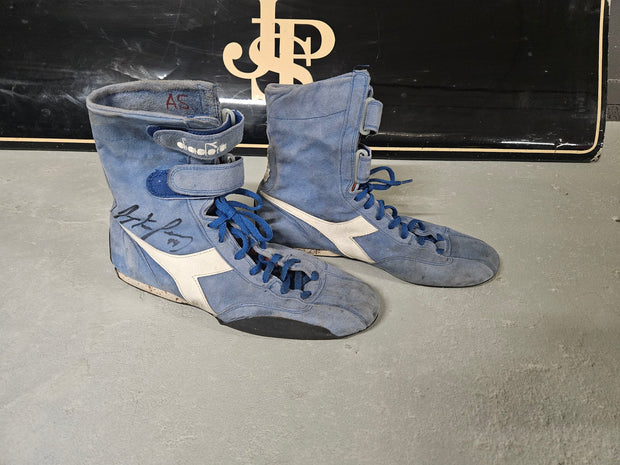
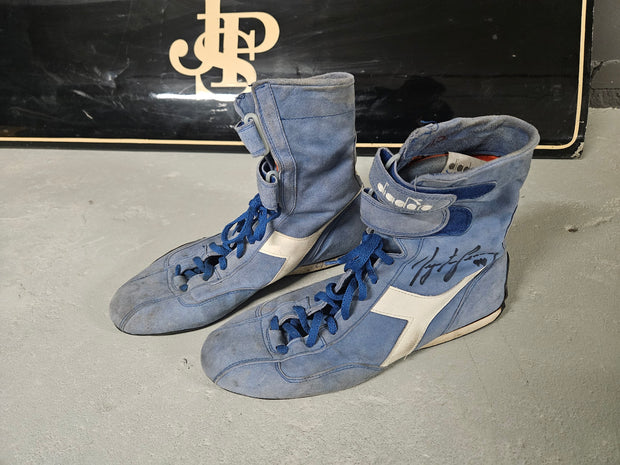
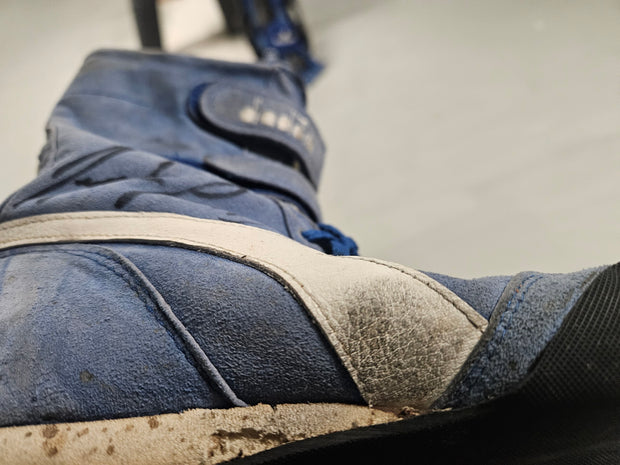
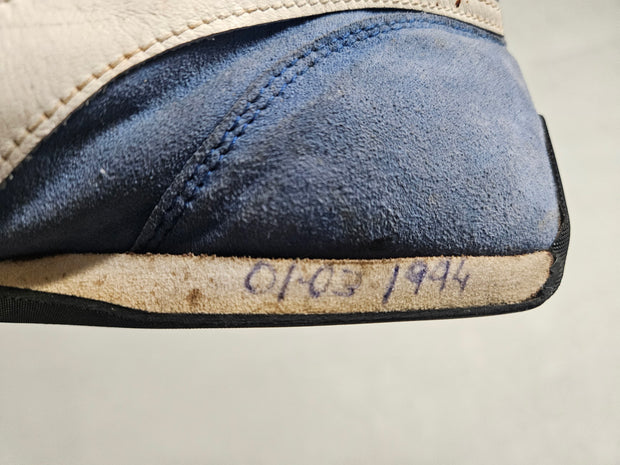
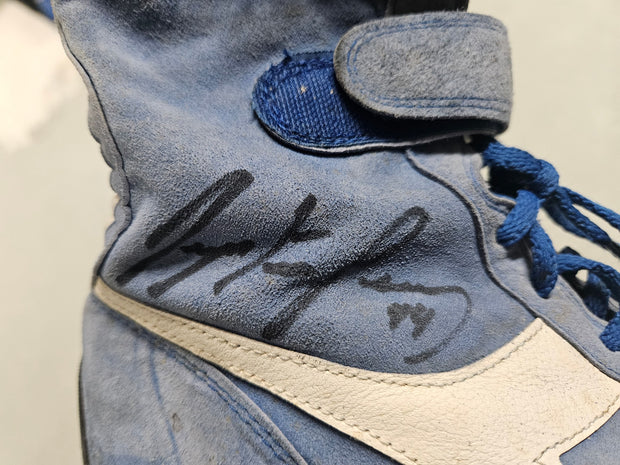
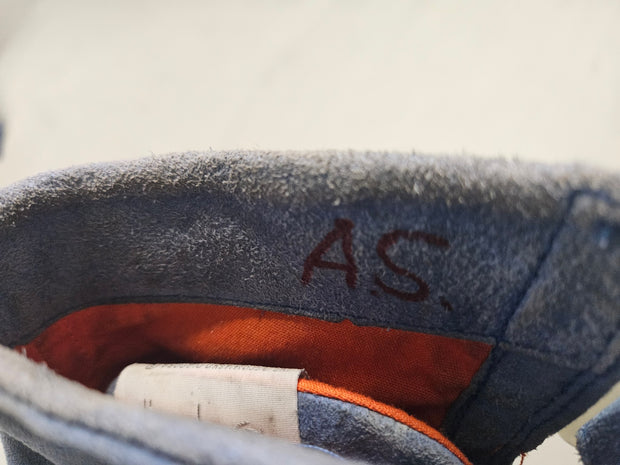
We have the matching shoes
Ayrton Senna Nomex OMP shirt and pants
Regular price
Another extremely rare set.
1- Ayrton Senna OMP Nomex shirt race used during the 1991 season. "A. Senna" sticker on the back part of the neck. It has been hand signed and dated by Ayrton Senna. OMP logo on each sleeve.
2- Ayrton Senna Nomex pants race used during the 1991 season. "A. Senna" sticker on the back part of the neck. It has been hand signed and dated by Ayrton Senna.
Can be purchased as a set or separately.
An identical OMP Nomex shirt fetched the equivalent of $50,000 at RM Sotheby’s (April 2025). Ours comes at a more accessible price—still premium, but far from cheap.
1989 Ayrton Senna Stand 21 race used NOMEX signed
Regular price
An original race used Stand 21 personal Nomex of Ayrton Senna during the 1989 season.
It has been hand signed in red marke by Senna in 1989.
A very collectable race worn item from one of the most successful driver in F1 history.
1994 Bell Vortex type SS Penske helmet with Senna's signed visor
Regular price
This is a rare Bell Vortex type SS Penske helmet. Inside the helmet are the appropriate Snell label and Honda inspection and build stickers.
A genuine, race used visor has been mounted on this helmet signed and dated by Ayrton Senna. This helmet comes at a portion of the Bell Vortex used by Ayrton Senna in 1994.