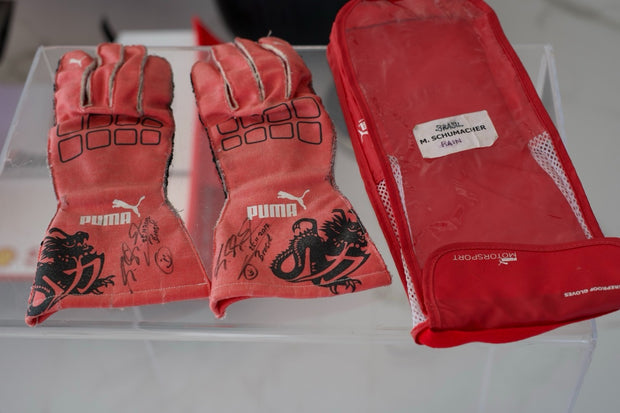
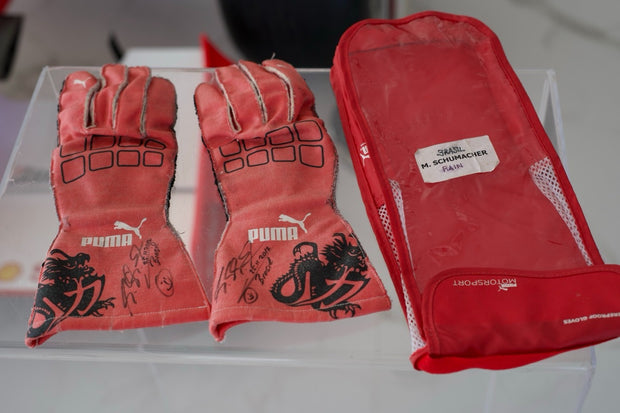
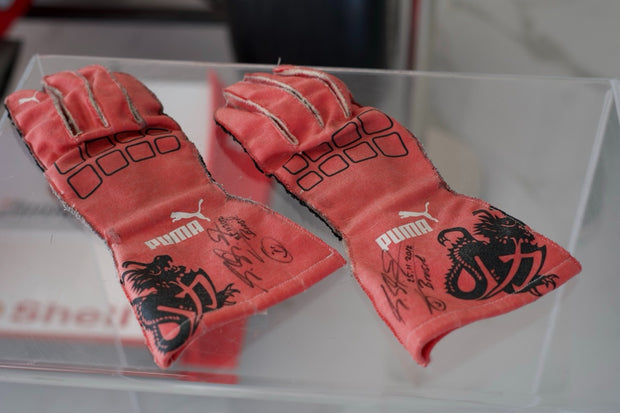
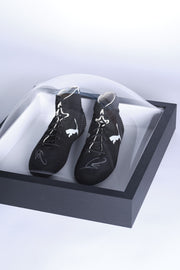
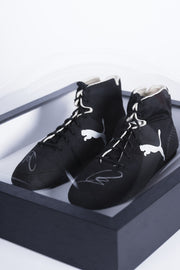
2012 Michael Schumacher PUMA Brazil GP signed gloves
Regular price
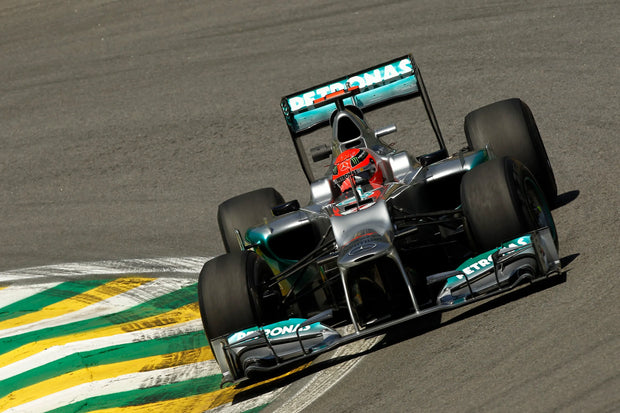
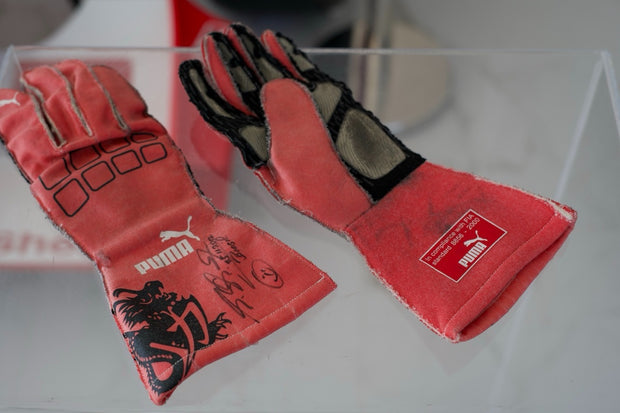
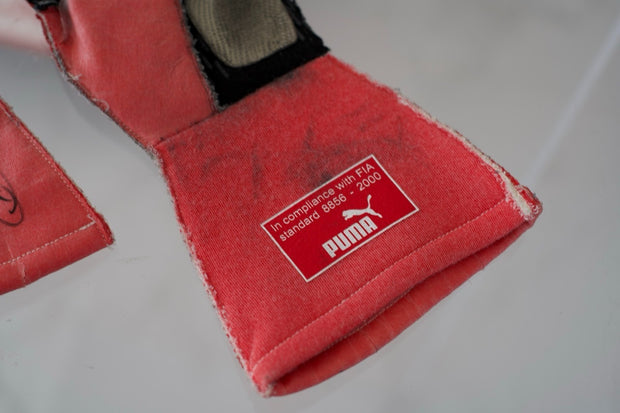
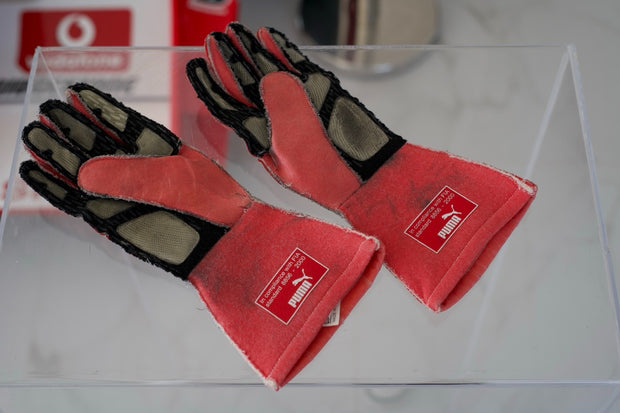
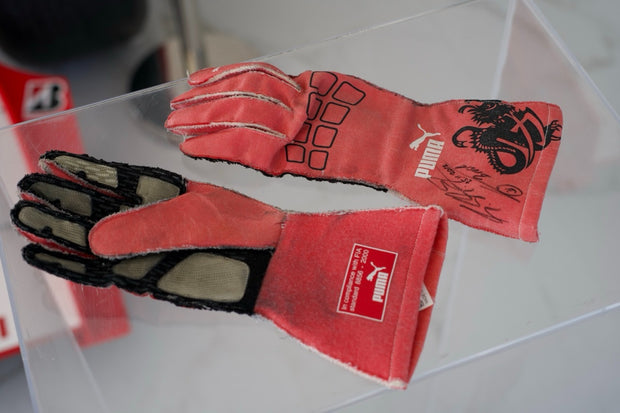
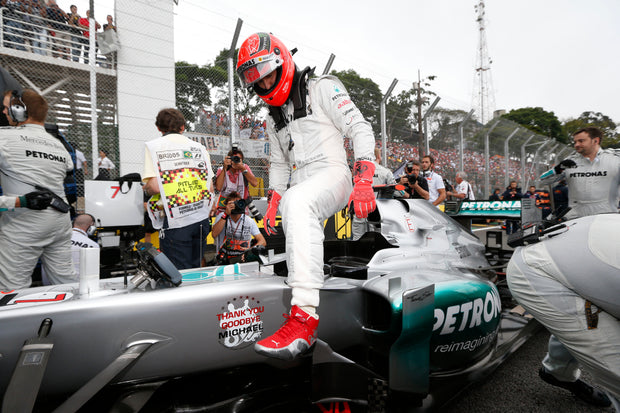
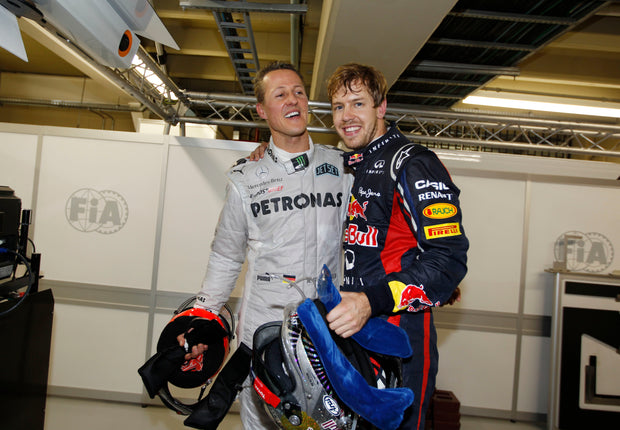
Exceptional Michael Schumacher Race-Worn F1 Rain Gloves – Final Grand Prix, Brazil 2012
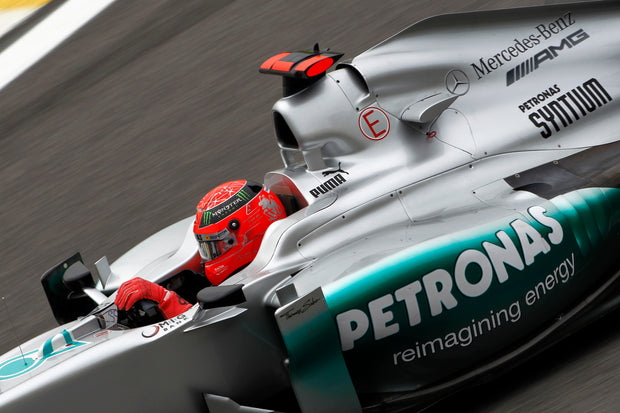
These gloves are not just a piece of Formula 1 history—they are a tribute to the legacy of one of the greatest drivers of all time. Worn and raced in by the legend himself, Michael Schumacher, these are the last gloves he ever used in a Formula 1 Grand Prix.
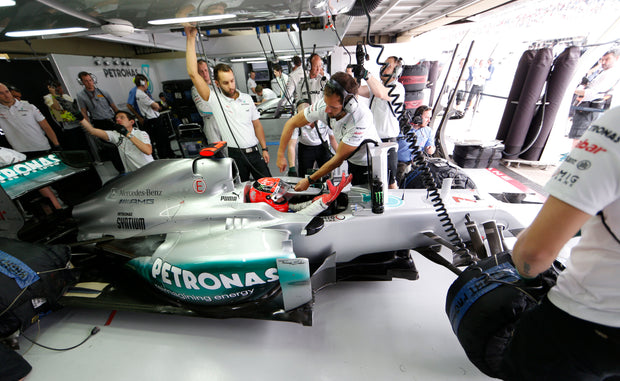
The Brazilian Grand Prix on November 25, 2012, marked the final race of the 2012 season and ultimately, the final Formula 1 race of Schumacher’s illustrious career. These are the actual rain gloves worn during that emotional farewell race.
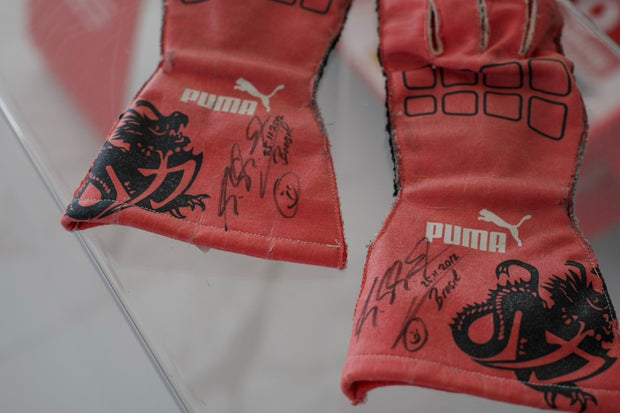
What makes this pair even more extraordinary is the personal touch added by Schumacher:
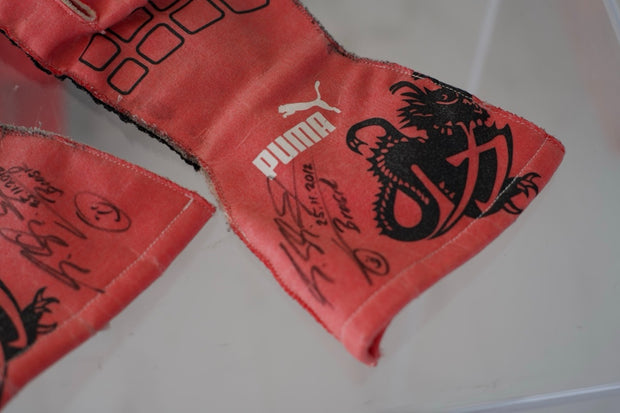
Hand-signed
Dated: 25.11.2012
Inscribed with: "Brasil"
Adorned with a smiley face, a symbol he reserved for special recipients—family, team members, close associates.
The gloves are accompanied by their original protective pouch, preserving their condition and provenance.
A rare opportunity to own an authentic, race-used artifact from the final chapter of a motorsport legend’s career. A true collector’s item for F1 enthusiasts and Schumacher admirers worldwide.
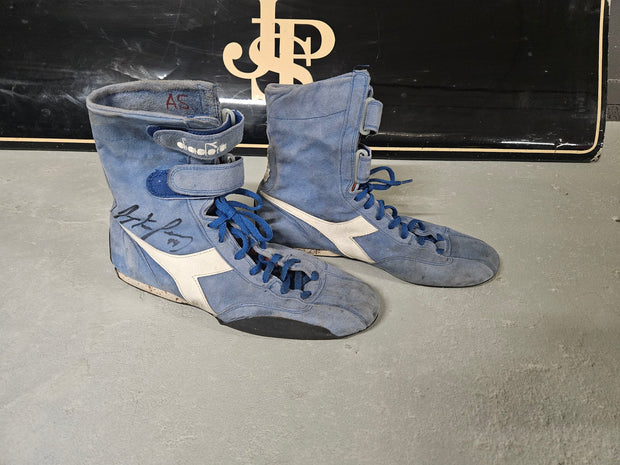
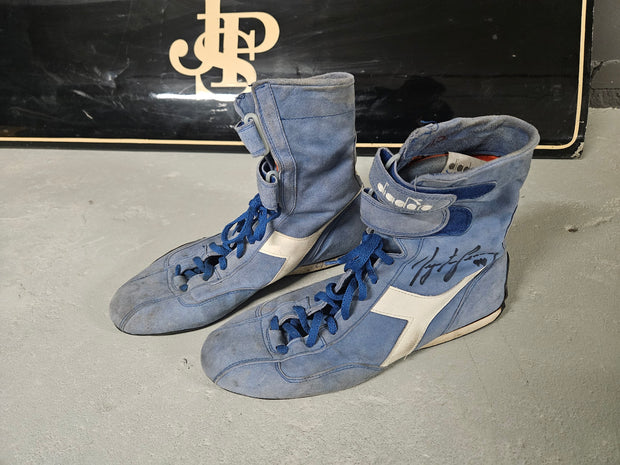
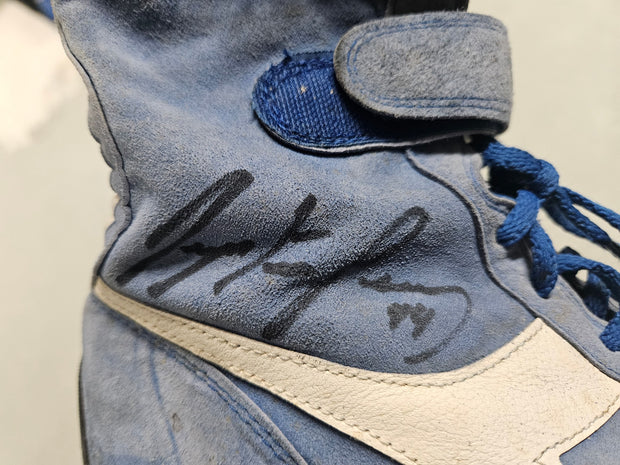
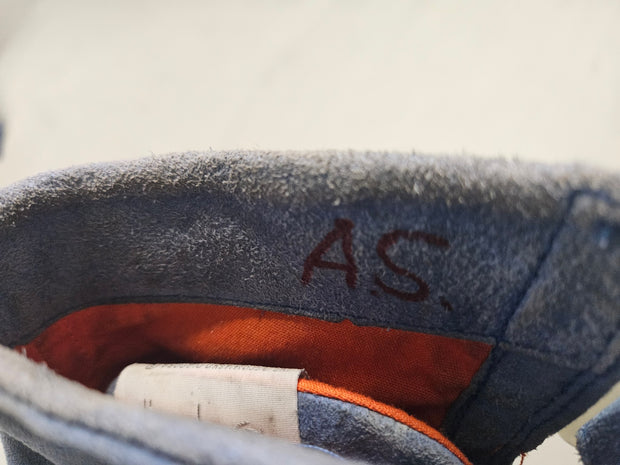
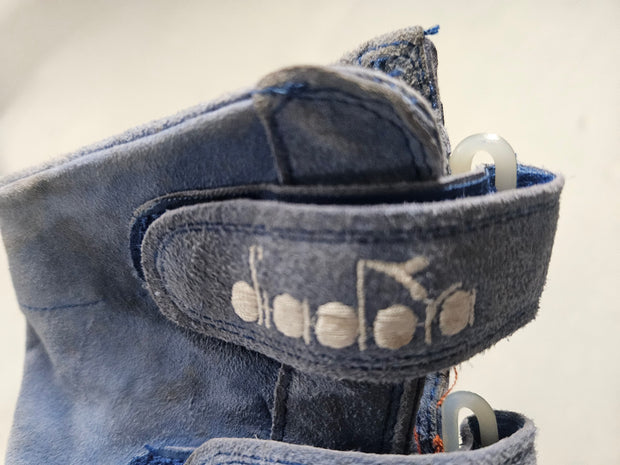
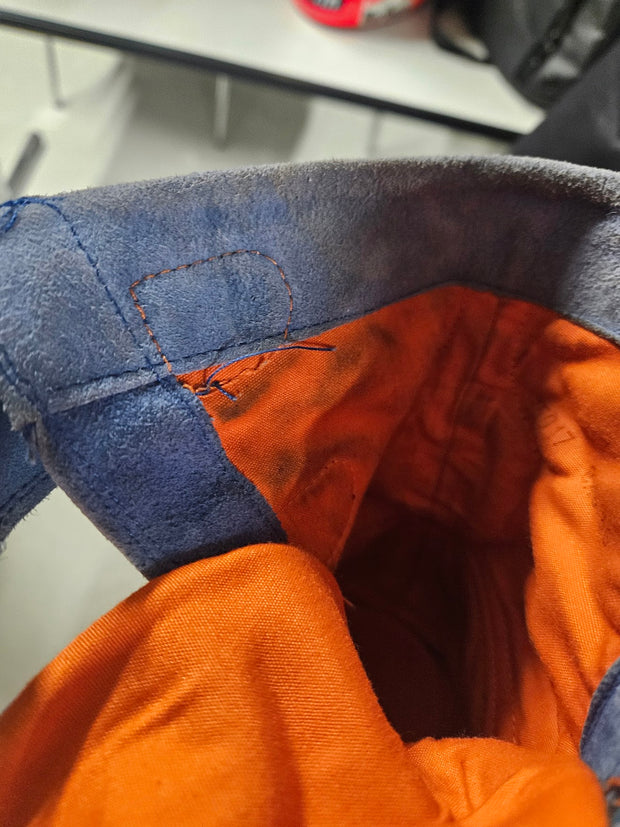
1994 Ayrton Senna Diadora testing shoes preseason signed
Regular price
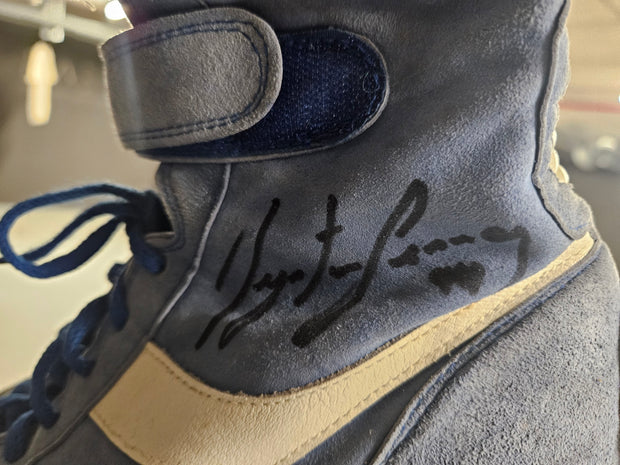
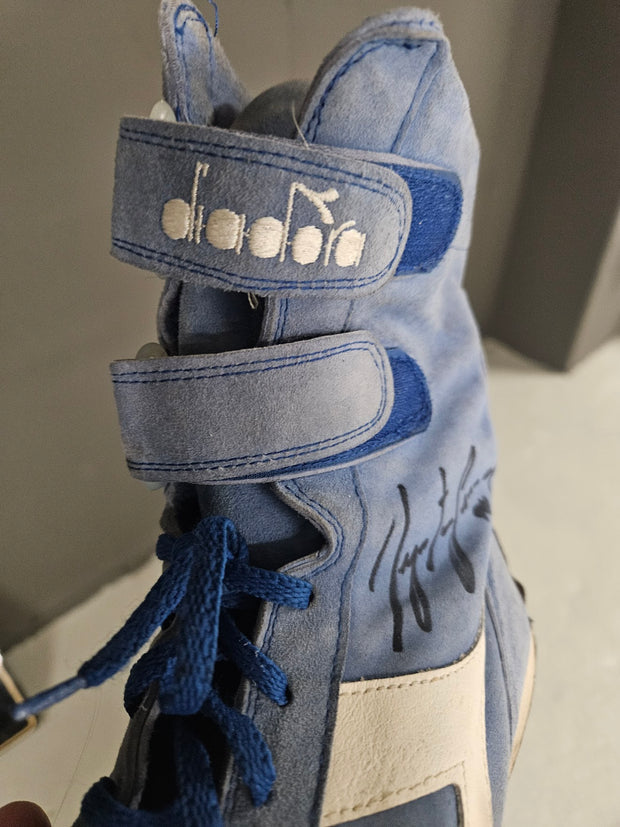
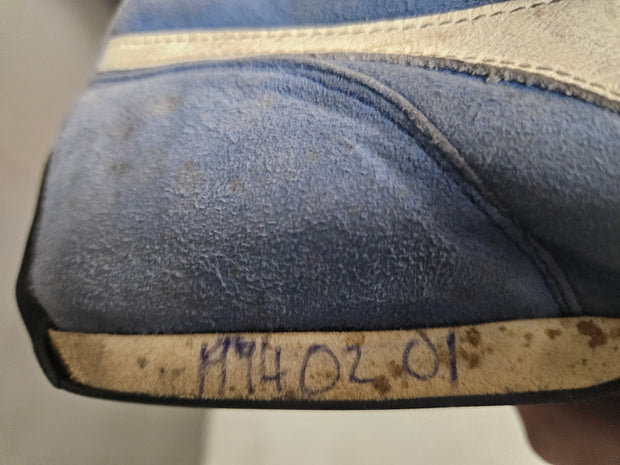
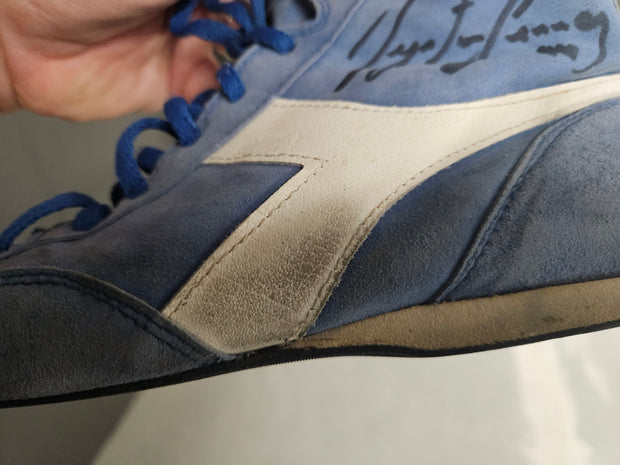
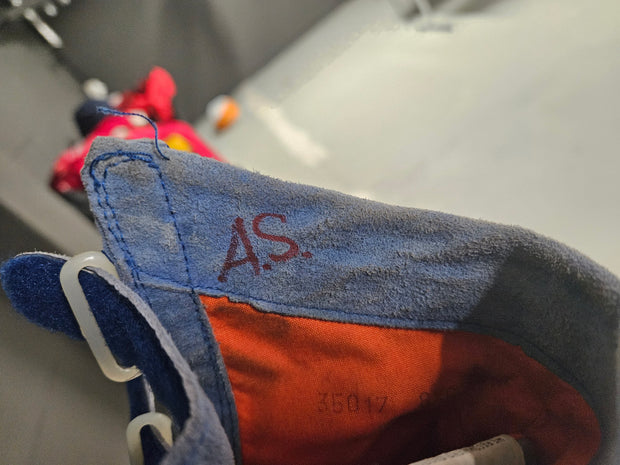
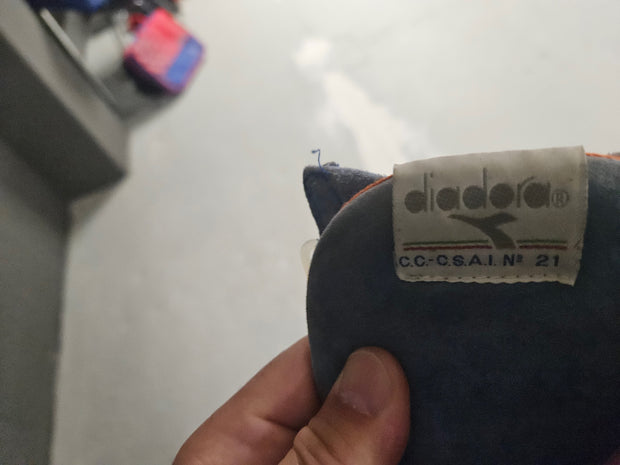
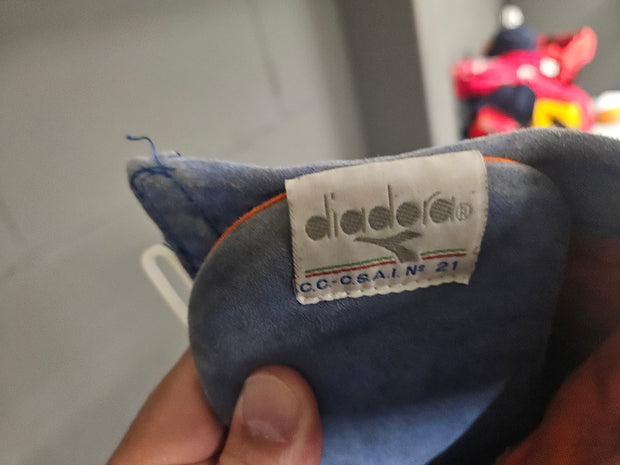
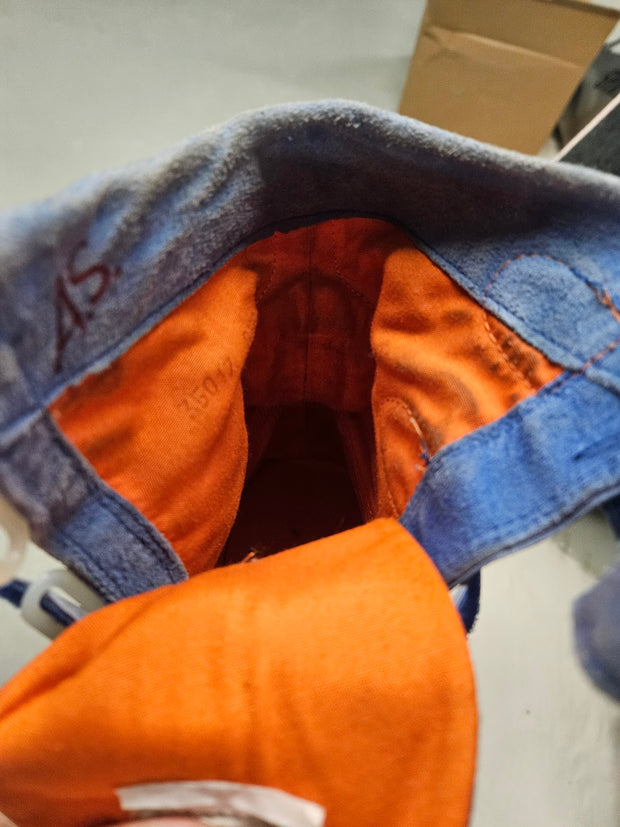
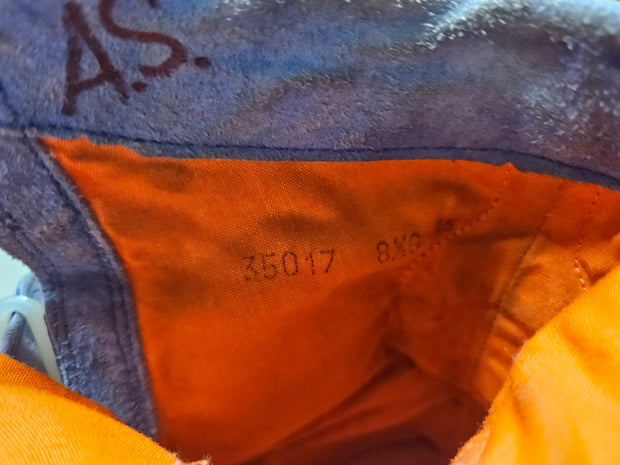
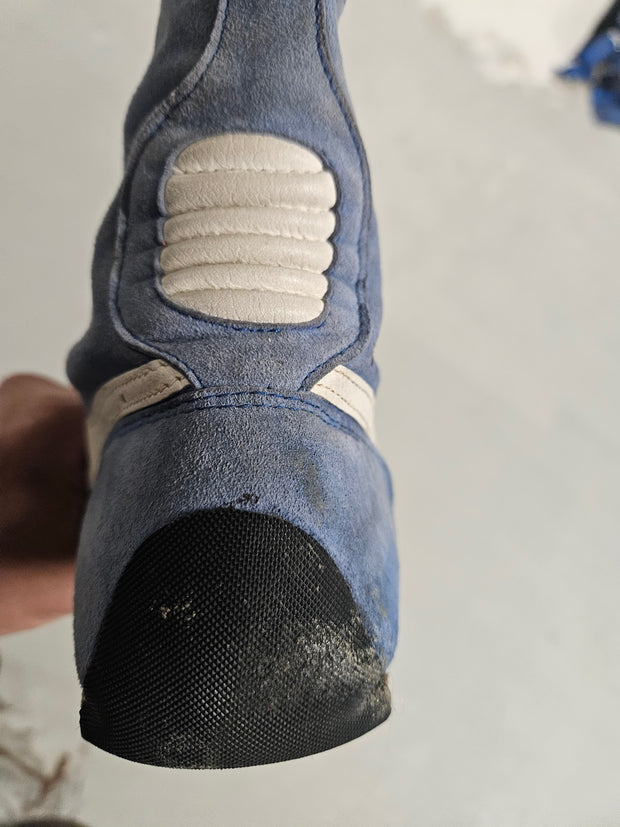
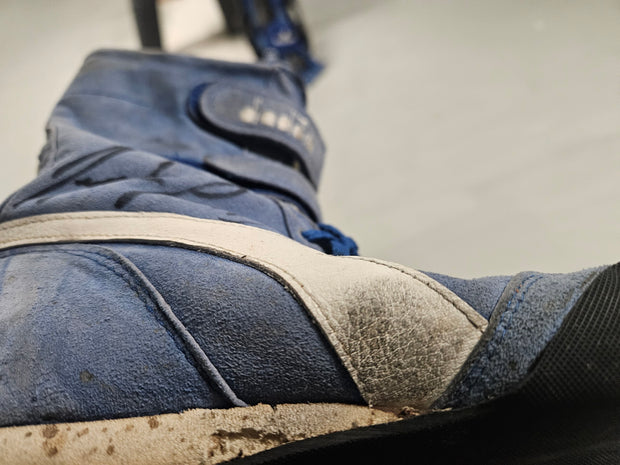
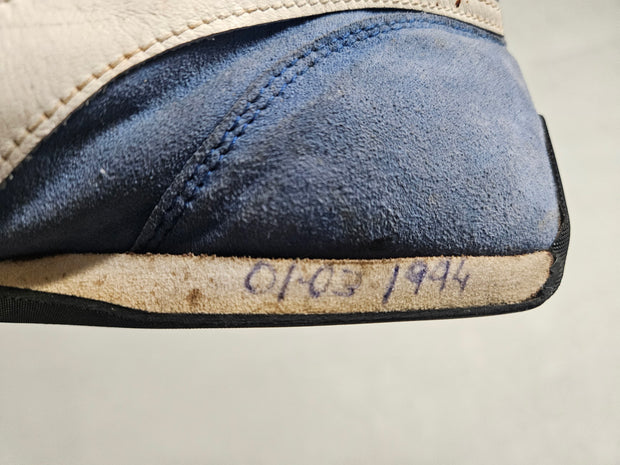
The folowing Diadora shoes have been used by Ayrton Seanna during the pre season testing sessions of the Tested in pre-season testing with the Williams FW15D in Imola. Tested as well with the Williams FW16 in Estoril.
Both shoes have been hand signed and dated in black marker by Ayrton Senna.
1994 Michael Schumacher SPARCO used gloves British GP signed
Regular price
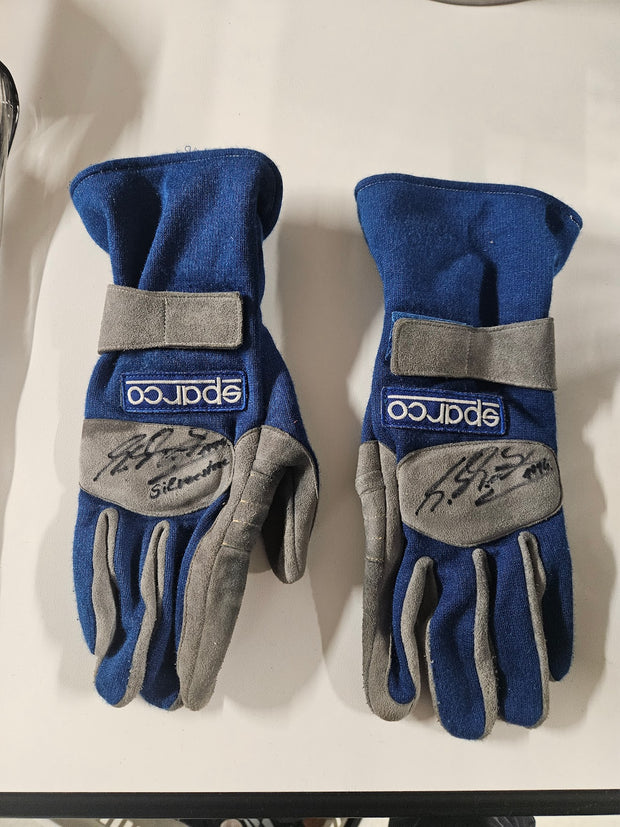
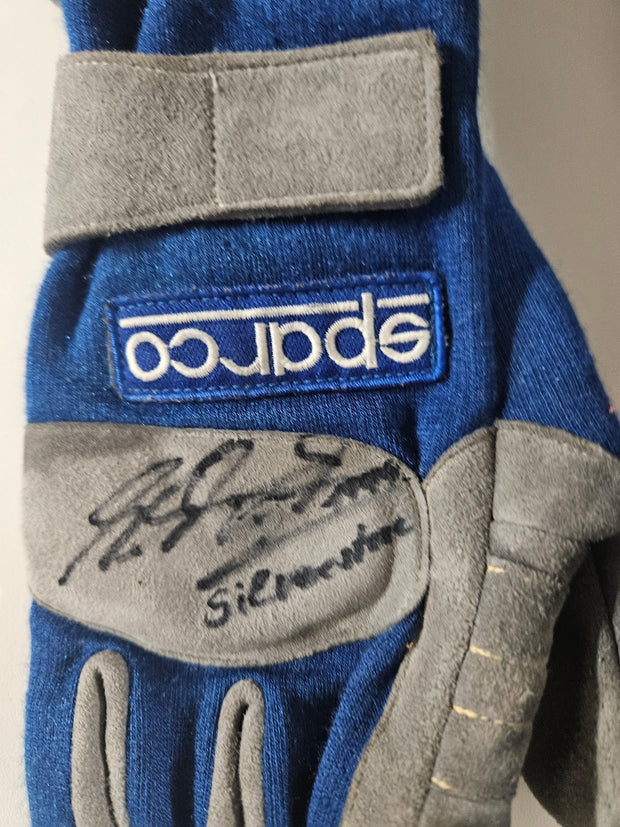
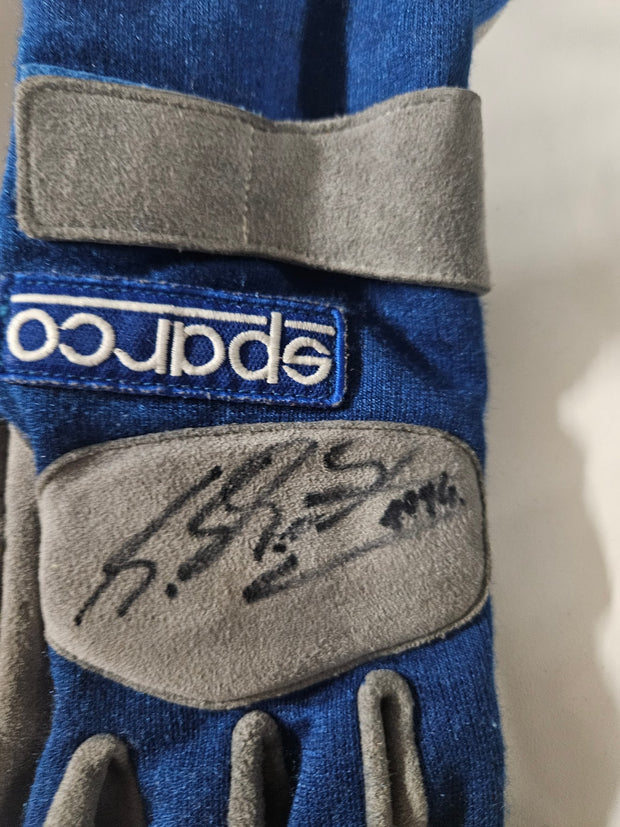
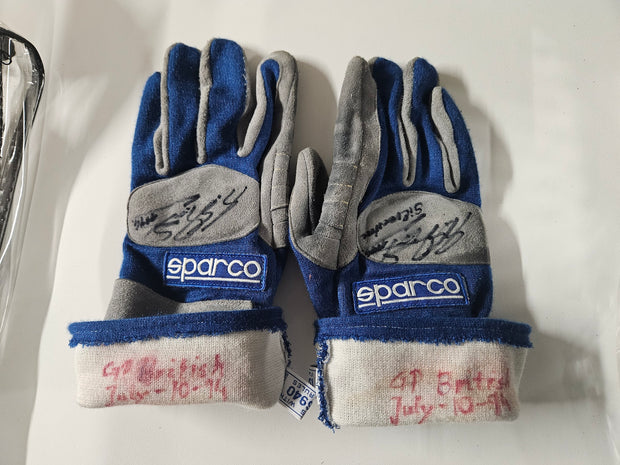
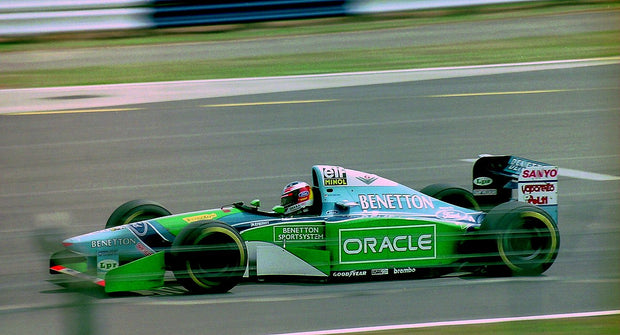
Sparco racing gloves worn by Michael Schumacher during the 1994 British Grand Prix at Silverstone.
Both gloves have been personally signed by Schumacher in black marker—one is inscribed with the date, and the other with the word “Silverstone.”
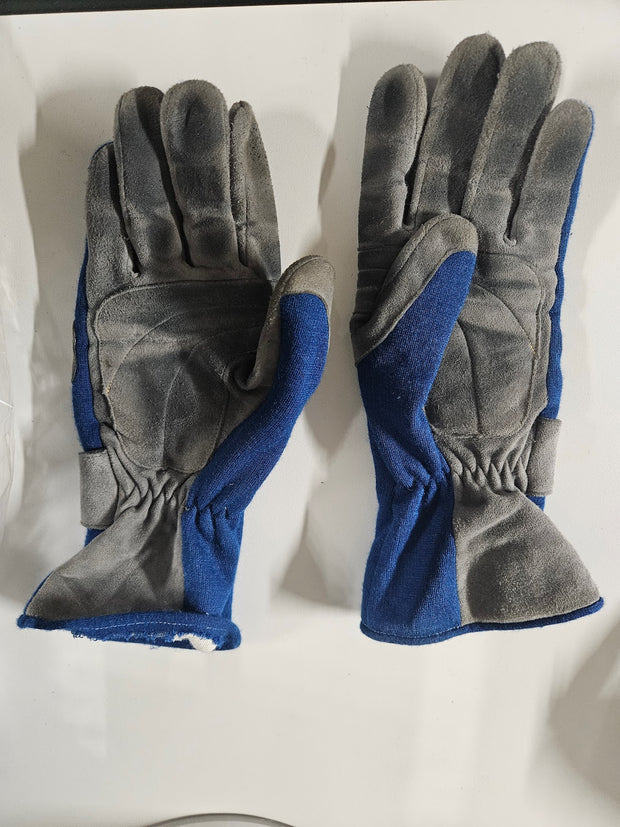
The gloves show significant signs of use, consistent with race wear. The interior of each glove is marked with “British GP July 10-94.”
We also hold the matching helmet from this Grand Prix in our collection
2009 The Stig Michael Schumacher gloves, and shoes set
Regular price
This is a very rare and desirable piece of TV and race memorabilia from one of the most legendary drivers of all time.
These gloves has been used during the Top gear episode by Michael Schumacher while driving the black Ferrari FXX. One glove is signed, the other has been signed, dated, with the mention "The Stig" and “1.10.7 min” as the lap time realized. Dated June 22, 2009 (2 days after Michael Schumacher revealed his identity as the STIG for the filming of Top Gear’s Series 13 Episode 1).
Helmet Not Included
1994 Ayrton Senna matching shoes and gloves signed AIDA GP
Regular price
This set of shoes and gloves is exceptionally rare. The Mizuno shoes, signed by Ayrton Senna, were custom-made exclusively for him for this particular race. Complementing the shoes, the OMP gloves are also signed and dated, with specific references to the race inscribed inside each glove.
Ayrton Senna 1987 F1 Race-Worn Balaclava — Hand-Signed
Regular price
Nomex balaclava worn by Ayrton Senna, 1987 FIA Formula One World Championship season, driving for Team Lotus. Letter of authenticity / provenance documentation available on request
Condition: Vintage, pre-owned condition with light wear consistent with race use and age.
1987 F1 Season — Ayrton Senna
1987 marked Senna's final season with Team Lotus before his move to McLaren. Driving the Lotus 99T — the team's first car powered by Honda turbo engines and fitted with revolutionary computer-controlled active suspension — Senna competed in the distinctive new Camel yellow-and-blue livery, replacing Lotus's old black-and-gold John Player Special colors. He won at Monaco and Detroit, took pole position at San Marino, and set fastest laps at Monaco, Detroit, and Italy, finishing the season with six podiums in total. These remain the last Grand Prix victories ever achieved by the Lotus team. Senna ended the year third in the Drivers' Championship, a season strong enough to secure his move to McLaren for 1988 — where he would claim his first World Championship title.
Willans Race-Used Seatbelt Harness — Lotus 99T, 1987 Formula One World ChampionshipWorn by Ayrton Senna Throughout the 1987 F1 SeasonHand Signed & Dated by Ayrton Senna in White MarkerAccompanied by John Player Team Lotus Certificate of Authenticity
To be held within a racing car by a seatbelt is, in a very literal sense, to be connected to the machine. To hold the very harness that held Ayrton Senna to one of the most technically advanced and visually iconic Formula One cars ever built is something altogether beyond the reach of ordinary collecting. This is precisely what is offered here.
The Harness
A complete Willans multi-point racing seatbelt harness in royal blue, bearing the manufacturer's name prominently woven into the shoulder straps — entirely consistent with the period-correct safety equipment supplied to top Formula One teams throughout the mid to late 1980s. The harness retains its original quick-release central buckle mechanism and all attachment hardware, in remarkable condition given its working life at the pinnacle of motorsport.
The central locking disc bears a yellow identification label reading "BRASIL / AYRTON SENNA / LOTUS 99T" — a period team-applied provenance marker that ties this piece directly and unambiguously to its driver and chassis.
Applied in white marker to the webbing, Ayrton Senna's signature appears alongside a date, making this an explicitly authenticated, personally inscribed artefact.
The Certificate of Authenticity
Presented in a black frame with the iconic John Player Team Lotus yellow mount, the certificate is issued by Team Lotus and formally states:
Component: Lotus 99T Seat Belts
Used in the year: 1987 F1 World Championship
Driver: Ayrton Senna
Signed: For and on behalf of Team Lotus
Dated: February 9th, 1989
Issued directly by Team Lotus and signed on behalf of the organisation, this certificate represents factory-level provenance of the highest order.
The Car — Lotus 99T Honda
The Lotus 99T was one of the most technically ambitious and visually arresting Formula One cars of its era. Designed by Gérard Ducarouge, it represented a landmark moment in motorsport engineering — Team Lotus joined forces with Honda, creating the 99T, recognised for its revolutionary Lotus Active Suspension, making it one of the fastest cars on the F1 circuit, especially with Senna at the wheel.
After Renault pulled out of F1 at the end of 1986, Lotus signed a deal with Honda for use of their hugely powerful turbocharged 1.5-litre engine. The computer-controlled active suspension system allowed the car to maintain a perfectly consistent ride height through corners and over bumps — a genuine technological revolution — giving Senna and teammate Satoru Nakajima a car that could stay flat over bumps, preserve tyres, and run less wing for more top speed.
Visually, the 99T marked a dramatic transformation. The famous black and gold of JPS made way for Camel's yellow and blue livery, turning the Lotus 99T into one of the most recognisable machines of the decade. The car was capable of achieving speeds of 340 km/h with its Honda Twin-Turbo V-6 engine, which put out a maximum 800 brake horsepower. Only six examples of the 99T were created for the 1987 F1 season.
The 1987 Season — Ayrton Senna & The Lotus 99T
1987 was a pivotal and bittersweet season for Senna. Competing against the dominant Williams-Honda FW11B of Nelson Piquet and Nigel Mansell — who had access to the superior specification Honda engine — Senna nevertheless extracted everything the 99T had to offer.
Senna achieved two race victories in 1987, claimed at the Monaco Grand Prix and the Detroit Grand Prix, as well as six other podiums throughout the season — four second places and two third places — finishing third in the Drivers' Championship with 57 points. These wins at Monaco and Detroit, along with the six additional podiums, represented a feat never to be repeated thereafter in F1 by a Lotus — marking the last time the great team would stand on the top step of a Grand Prix podium.
It was Senna's final season with Lotus. The following year, he made the move to McLaren — taking Honda's engines with him — and claimed the first of his three World Championship titles. The Lotus 99T, and the 1987 season, therefore represents the final chapter of one of the most important partnerships in Formula One history: Senna in yellow and blue, before the red and white years that would define a generation.
A Note on Significance
Race-used seatbelt harnesses are among the most intimate and personal artefacts that survive from a driver's career. They are not components of the car — they are the interface between the man and the machine. A belt that held Senna in place through Monaco's hairpins and Detroit's walls, through qualifying laps, race starts, and podium celebrations, is a piece of history that no replica, photograph, or print can approach.
Signed. Certified. Race-used. Irreplaceable.
Estimate: Upon request
1991 Michael Schumacher "Canada" race used shoes
Regular price
The following shoes are exceptional, this is the only pair known to have been worn and race used by Michael Schumacher. The brand is "Canada", Michael Schumacher worn the shoes during the only major international race held at Autopolis which was the final race of the 1991 World Sportscar Championship season, the 1991 430km of Autopolis, which waswon by Michael Schumacher and Karl Wendlinger in a Mercedes-Benz C291 fielded by Sauber.
1994 Ayrton Senna signed race used shoes
Regular price
These signed, race-used boots from Ayrton Senna's 1994 season are incredibly significant, especially as they were worn during his final months. Signed and dated, they are a poignant reminder of his lasting legacy in Formula 1.
The shoes exhibit significant signs of use.
1979 Gilles Villeneuve race used gloves signed
Regular price
1979 Gilles Villeneuve Simpson race used gloves signed.
Used during the 1979 USA GP in Long Beach while driving the Ferrari 312 T4.
The gloves show heavy signs of use and aging. They have also been used for several testing.
1993 Ayrton Senna Sabelts signed and dated
Regular price
Very rare and desirable: Ayrton Senna Sabelts protections.
Hand signed and dated in black marker by the legend himself.
1987 Ayrton Senna Stand 21 race used gloves signed
Regular price
A pair of Ayrton Senna Stand 21 race gloves, worn during the 1987 Formula 1 season. Both gloves are hand-signed and dated by Senna and his teammate, Satoru Nakajima, from the Lotus team.
They show heavy signs of use.
1987 Ayrton Senna Monaco GP signed race used shoes with Lotus CoA
Regular price
AYRTON SENNA — RACE-USED, SIGNED & PHOTO-MATCHED ADIDAS RACING SHOESMonaco Grand Prix, 31 May 1987 — Camel Team Lotus Honda
We are extremely pleased to present an exceptional artefact from one of the defining moments of Ayrton Senna's career: the pair of black Adidas racing shoes worn by Senna during his victory at the 1987 Monaco Grand Prix.
Driving the Lotus 99T-Honda, Senna claimed his fifth Formula 1 victory that afternoon in the Principality — and his first at Monaco. It was a win of unusual historical weight. Beyond marking the opening chapter of what would become an unmatched record of six Monaco victories, it was also the first Grand Prix ever won by a car equipped with active suspension, and the first win of the Senna–Honda partnership that would go on to define the sport's next era. On the podium, before Prince Rainier III and Prince Albert of Monaco, a 27-year-old Senna raised the winner's cup wearing these very shoes — a moment captured in the period photography accompanying this lot, to which the shoes have been conclusively photo-matched, the distinctive gold three-stripe Adidas boots clearly visible at his feet.
The shoes are among only three black pairs produced for Senna during his tenure with Team Lotus. Each shoe is hand-signed by Senna in white marker, with "A. Senna" inscribed to the interior alongside the manuscript date "31/5/87" — the date of the race itself — applied in his own hand. The gold heel panels carry the Adidas Trefoil, and the suede uppers, laces and double Velcro straps show significant, honest signs of competition use throughout: scuffing to the toes, wear to the gold striping, and soiling consistent with a full race distance on the streets of Monte Carlo.
The lot is accompanied by an official certificate issued by Team Lotus attesting to authenticity and provenance, and is presented on a bespoke display plinth with engraved plaque reading "Ayrton Senna da Silva — Racing Shoes — Formula 1 World Championship — Monaco GP 1987."
Race-worn Senna equipment from a victory — let alone a maiden Monaco victory, signed, dated and photo-matched — is of the utmost rarity. This is a museum-grade piece from the very heart of the Senna legend.
On the significance of the race: Monaco 1987 is arguably the single most consequential of Senna's early wins. It began the Monaco dynasty — six wins in total, five of them consecutive from 1989 to 1993, a record still unbeaten — on the circuit that became synonymous with his genius. Technically, the 99T's victory was the first for active suspension in F1 history, and it cemented the Honda relationship that Senna would carry to McLaren and three world championships. His podium alongside Prince Rainier that day is one of the iconic images of the decade.
1984 Ayrton Senna Stand 21 used gloves signed
Regular price
Stand 21 gloves used by Ayrton Senna during the 1984 season.
Both gloves have been hand-signed and dated using a black ink marker and possess considerable significance. Notably, 1984 marked the debut of Senna in Formula 1, a year that would become a pivotal cornerstone in the history of F1.
Both gloves exhibit significant signs of wear.
In 1984, Ayrton Senna made his inaugural appearance in the highly competitive world of motorsport’s premier category, Formula 1. Taking the wheel for the small team Toleman, Senna embarked on his Formula 1 journey, an expedition that would eventually lead him to remarkable achievements.
The captivating tale of Senna’s Monaco reign commenced in 1984, marked by an awe-inspiring performance during a rain-soaked race. There, he conquered his first podium finish in Formula 1, securing the second position behind Alain Prost’s McLaren.
1990 Nigel Mansell OMP used gloves signed
Regular price
These OMP racing gloves were used by Nigel Mansell during the Mexico Grand Prix on June 24, 1990. Both gloves have been autographed in black marker.
After Canada came the Autodromo Hermanos Rodriguez in Mexico City and Berger qualified on pole position with Patrese beside him and Senna third, Mansell fourth, Boutsen fifth and Alesi sixth. At the start, Patrese and Berger jumped Senna while Piquet got ahead of Boutsen and Mansell. Early on, Senna passed Patrese and Berger followed him through. Patrese was dropping back and Piquet got by him as well. Boutsen was the next to go through but at the same time Berger had a problem with his tyre and was forced to stop and dropped to 12th position. Senna lead from Piquet, Boutsen, Patrese, Mansell and Prost.
Soon, Mansell passed Patrese and got Boutsen four laps later as Prost did the same to Patrese. Prost sneaked ahead of Boutsen as Mansell closed in on Piquet. Mansell got ahead on lap 36 and Prost followed him through six laps later. Piquet soon stopped and dropped behind Nannini, Boutsen (who already stopped) and Berger. Berger passed Boutsen on lap 47 and Nannini four laps later. Prost passed Mansell on lap 55 and they began to close in on Senna. Prost, passed Senna followed by Mansell. Then Mansell spun but at the same time Senna got a puncture that let to him retiring in the pits 4 laps before the end and allowing Berger to get third and close in to Mansell. With a daring move Berger passed Mansell but Mansell charged back and attacked taking back second place after making an even more daring pass around the outside of Berger at the fastest corner on the track, the 180-degree Peraltada corner. Prost won with Mansell second making it a Ferrari 1–2 ahead of Berger, Nannini, Boutsen and Piquet.
1993 Ayrton Senna OMP used balaclava signed
Regular price
An extraordinary and historically significant piece of Formula 1 memorabilia — this original OMP fireproof balaclava was worn by Ayrton Senna during the 1993 Brazilian Grand Prix, held on March 28th, 1993 at Interlagos. That weekend, Senna delivered one of his most iconic performances, securing pole position in front of his home crowd while driving for McLaren-Ford, marking a defining moment in his career and legacy.
The balaclava features the OMP manufacturer’s embroidered tag at the base, confirming its authenticity as professional-grade racing gear used during that era. Inside the lower edge is a factory-applied label reading “A. SENNA” in red lettering, matching the specification used by McLaren team equipment during the 1993 season.
Most notably, the balaclava has been personally hand-signed and dated by Ayrton Senna in blue ink on the front. The signature was applied the same day at Interlagos, immediately following qualifying, making this a race-used, pole position–signed artifact — an exceptionally rare convergence of provenance and historical importance.
Details:
Driver: Ayrton Senna
Team: McLaren-Ford
Grand Prix: Brazilian GP, Interlagos, March 28, 1993
Result: Pole Position (1st on grid)
Manufacturer: OMP
Type: FIA-approved fire-resistant racing balaclava
Features: Embroidered OMP logo patch, internal “A. SENNA” name tag, visible race wear from use
Autograph: Hand-signed and dated by Ayrton Senna in blue marker
Condition: Excellent display condition with light race wear; signature remains clean and legible
The presence of the internal “A. SENNA” tag and authentic OMP patch corroborate its original race-issue status. The autograph, dated from the same day, further authenticates its historical value.
Notes: A museum-grade collectible from one of the most revered figures in motorsport history. This signed, race-used balaclava captures the essence of Senna’s final years in Formula 1 and his deep bond with Brazil. An extremely rare opportunity for collectors and institutions to acquire a pole position–worn and signed artifact from the greatest driver of his generation.
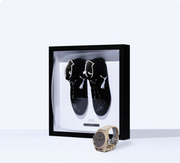
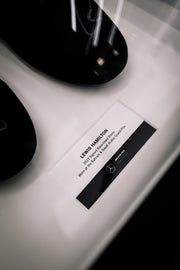
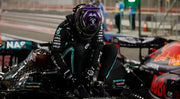
2022 Lewis Hamilton race used Puma shoes & IWC Big Pilot watch
Regular price
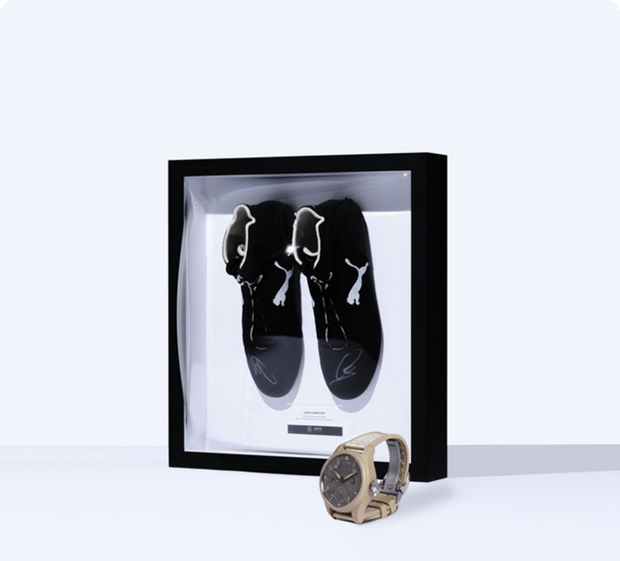
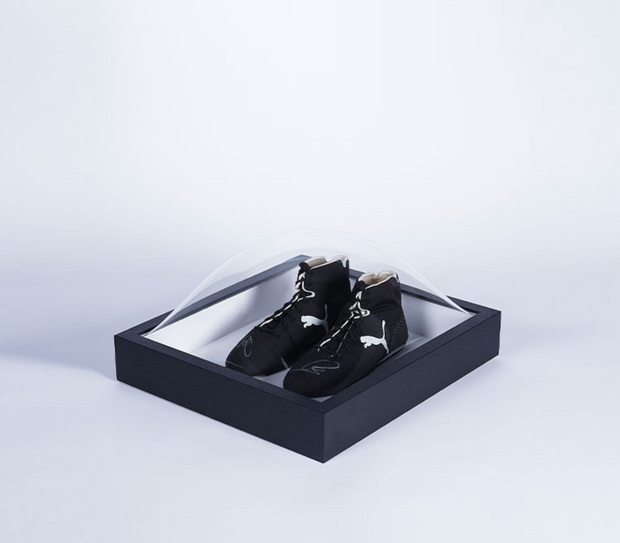
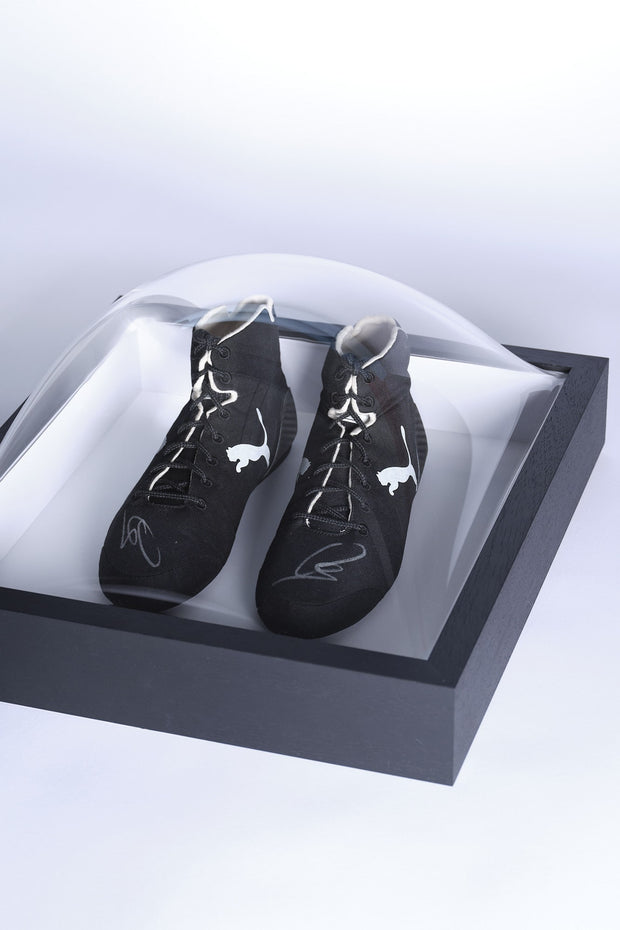
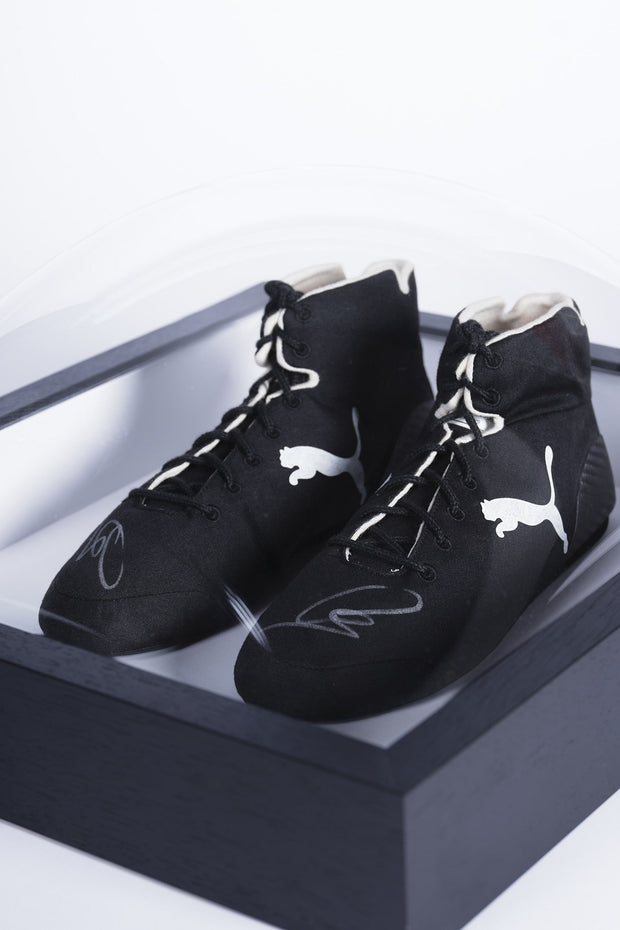
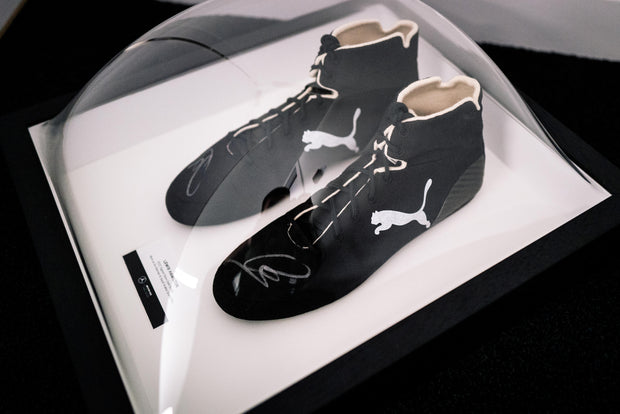
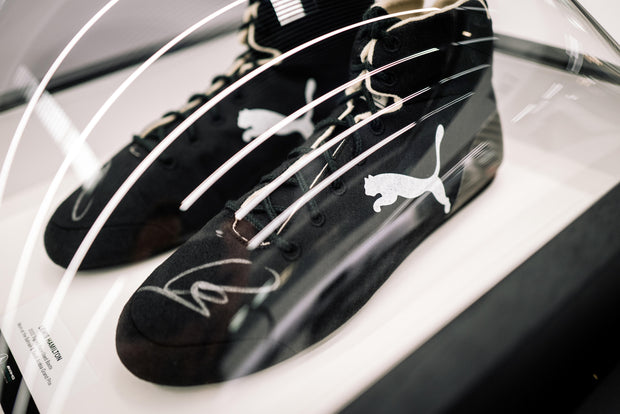
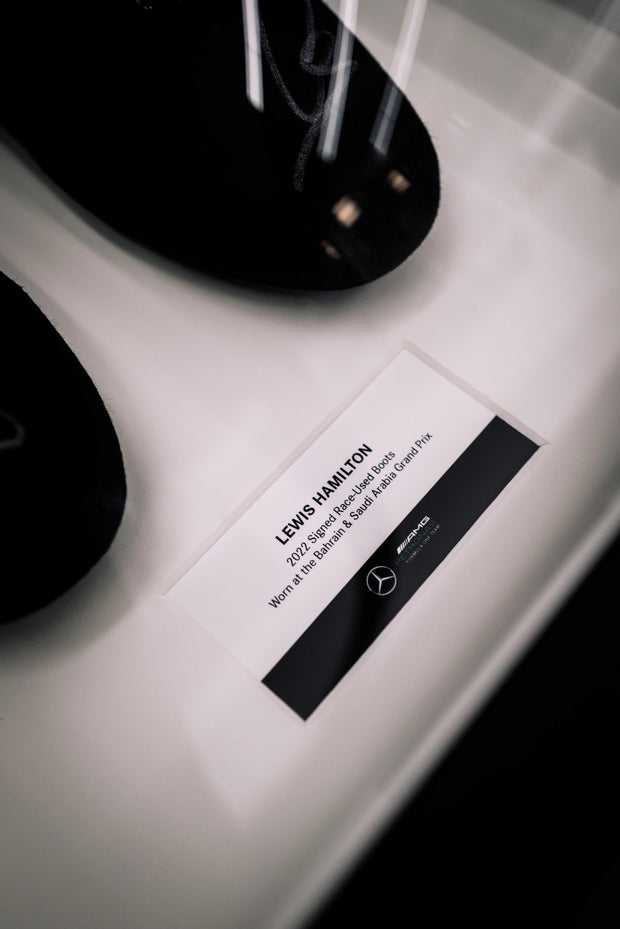
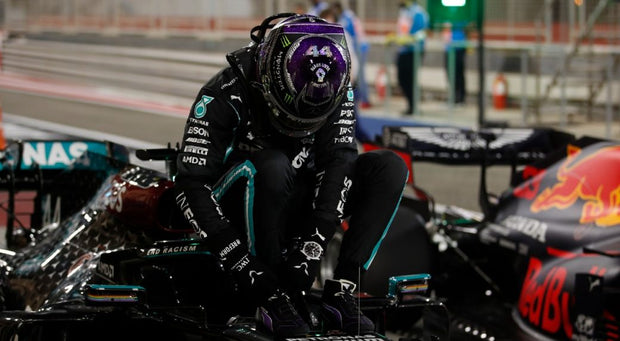
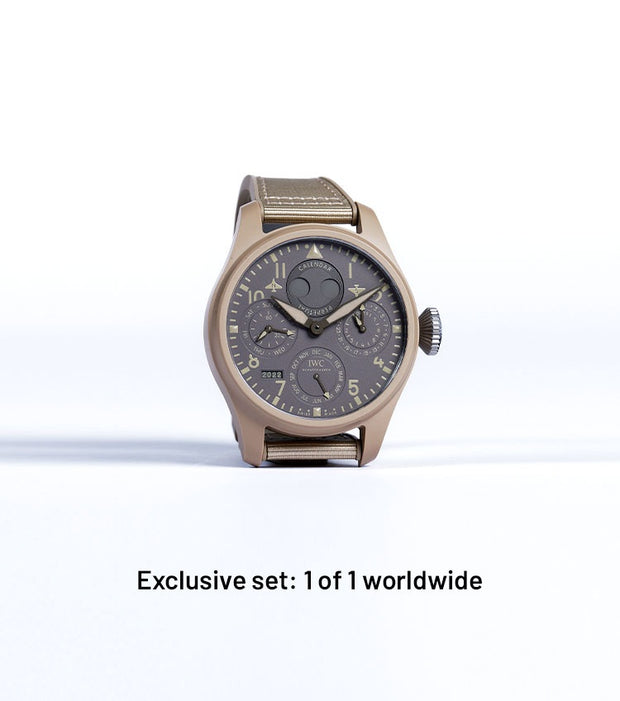
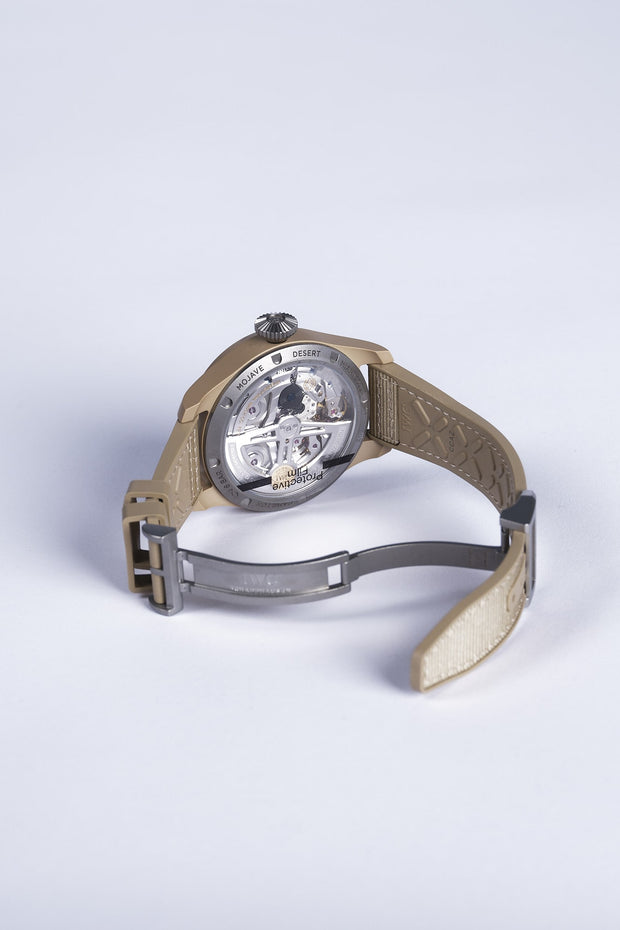
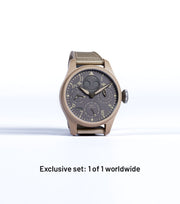
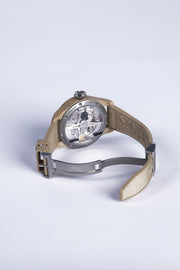
This is a unique set: 2022 race used Puma shoes hand signed by Lewis Hamilton + Lewis Hamilton personal IWC Big Pilot Perpetual Calendar Top Gun.
Puma Speedcat Pro in size EU 43.5 (US 10.5), worn and signed by Lewis Hamilton (season 21/22 in Bahrain and Saudi Arabia).
Piece unique (1:1), IWC Big Pilot's watch Perpetual Calendar Top Gun Edition "Mojave Desert", Ref. IW503004, worn by Lewis Hamilton. Accompanied by: Signed note from Lewis Hamilton, watch box and watch pouch made of leather, Documentation, Operating Instructions, polishing cloth, 6-year extension to the standard 2-year International Limited warranty. The watch is engraved with “ Lewis Hamilton Miami 2022“
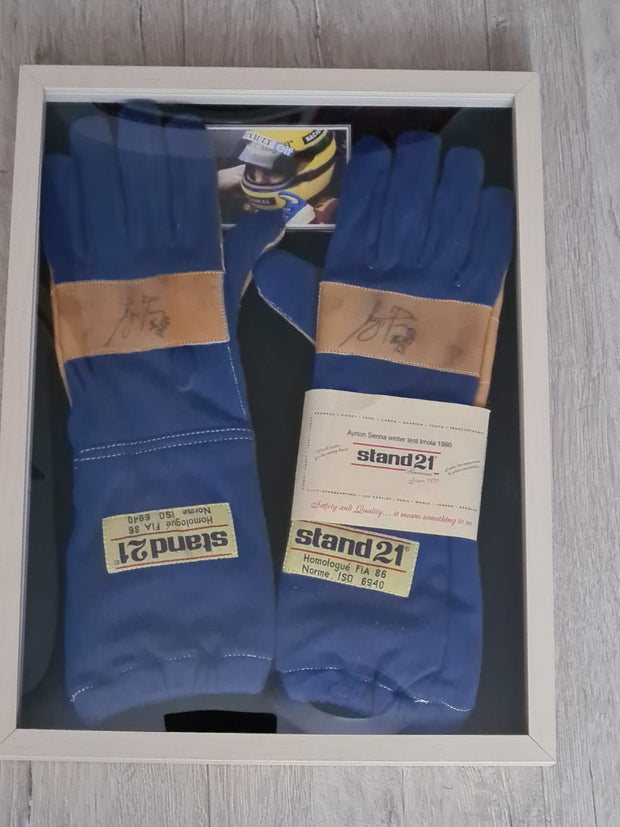
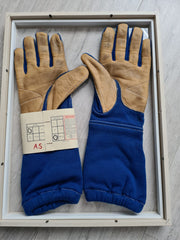
Ayrton Senna Stand 21 Race Gloves Winter Testing, Imola 1986
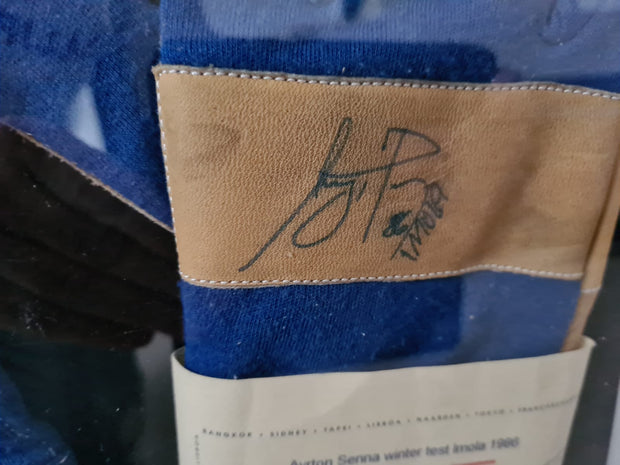
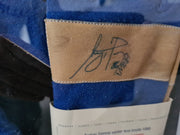
Signed and Inscribed “Imola” in blue ink Provenance: Stand 21 Racewear, Dijon, France
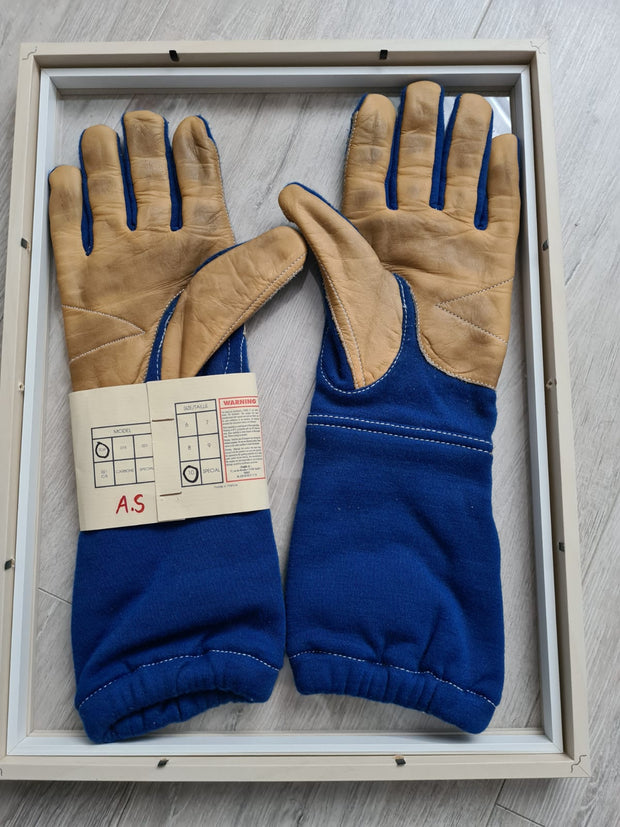
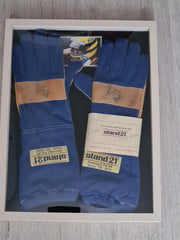
A pair of original Stand 21 race gloves worn by Ayrton Senna during pre-season testing at Imola in 1986, representing one of the earliest artifacts from the Brazilian legend’s formative years in Formula 1.
Constructed in blue Nomex and tan leather, these gloves were produced by Stand 21, the French manufacturer renowned for outfitting elite drivers with FIA-approved safety gear. Both gloves are hand-signed and dated by Senna, who also inscribed the name “Imola”, marking the exact location of their use.
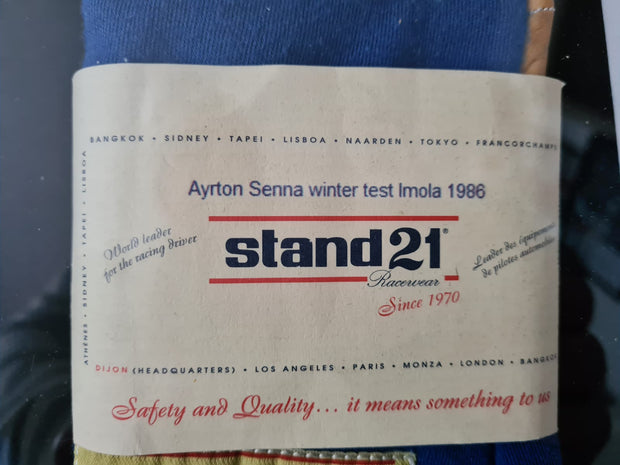
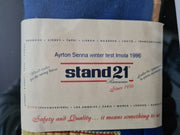
Accompanying the pair is an exceptionally rare original Stand 21 factory wrap, which explicitly identifies the gloves as “Ayrton Senna winter test Imola 1986”. This label confirms their provenance directly from the supplier responsible for Senna’s racewear at the time, adding an extraordinary level of authenticity.
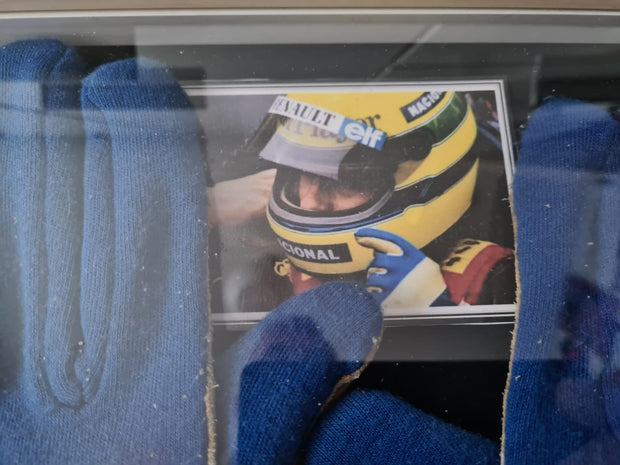
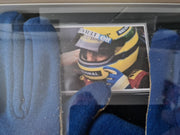
These gloves are presented framed with a period photograph of Senna donning similar blue gloves and his iconic yellow “Nacional” helmet, capturing the intensity and focus that defined his early racing years with Team Lotus.
Items directly tied to Senna’s 1986 testing period—when he fine-tuned the legendary Lotus 98T—are exceptionally scarce, and few possess such impeccable provenance.
Description:
Original Stand 21 gloves used by Ayrton Senna, Imola winter test 1986
Signed and inscribed “Imola” by Senna in blue ink
Retains original Stand 21 factory wrap marked “Ayrton Senna winter test Imola 1986”
Presented framed with a period photo
In excellent, well-preserved condition
Dimensions (framed): Approx. 45 x 35 cm Estimate: USD 25,000 – 40,000 Offered with Certificate of Authenticity
A museum-grade artifact of Ayrton Senna’s early Formula 1 career, encapsulating the passion, precision, and spirit of one of motorsport’s greatest icons.
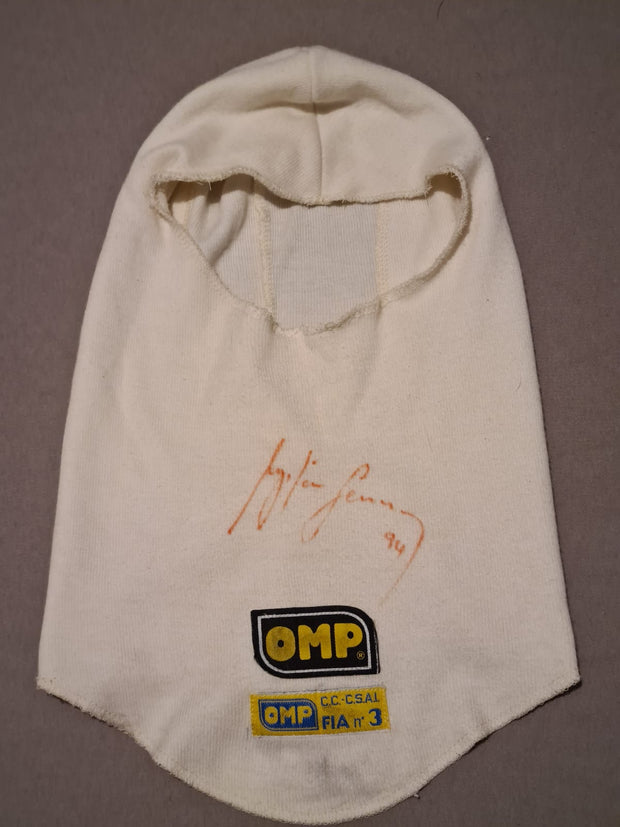
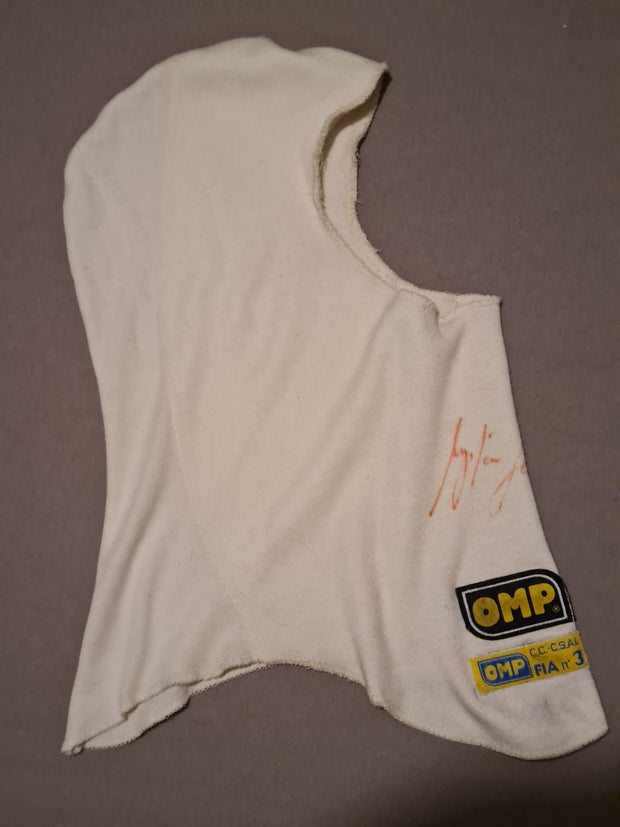
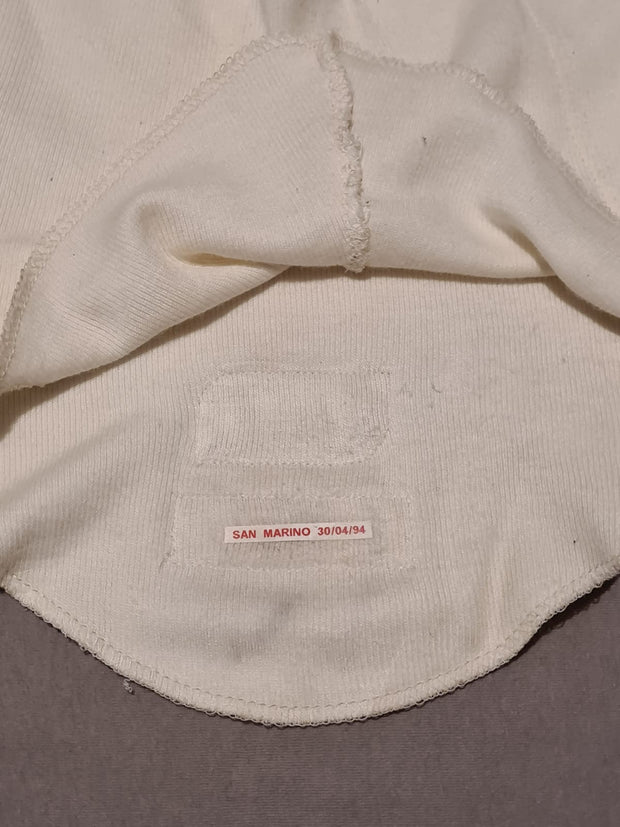
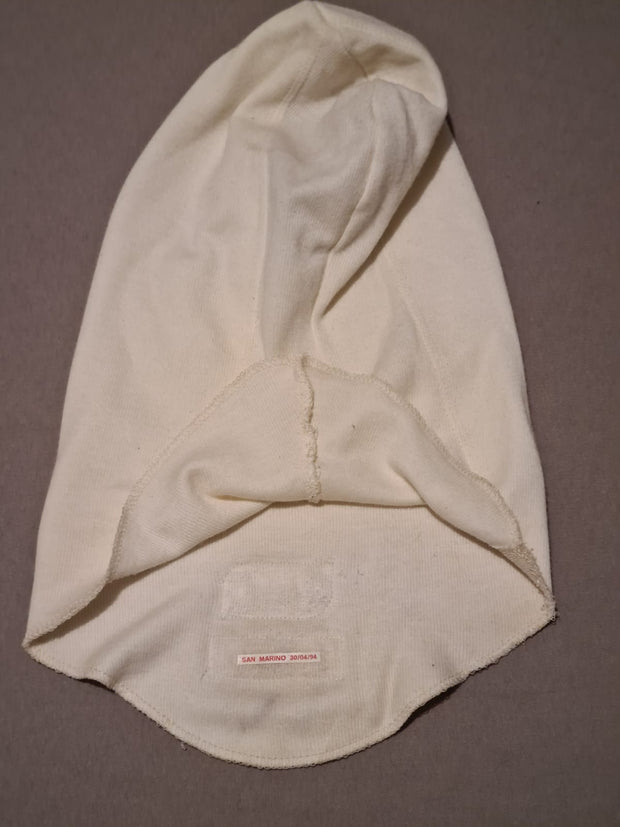
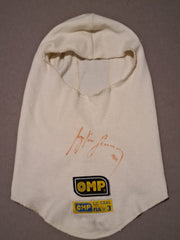
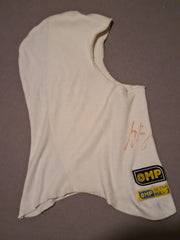
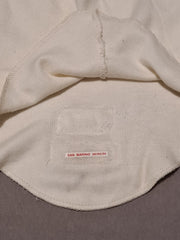
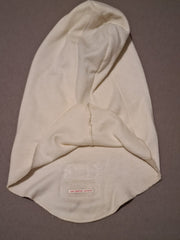
1994 Ayrton Senna OMP used balaclava signed
Regular price
This original race OMP balaclava has been used by Ayrton Senna during the qualifying in Imola on April 30th, 1994. 1 day before his tragic death.
It has been hand signed and dated by Senna the same day.
This piece has an historical and tragic significance.
Accompanied by our certificate.
Ayrton Senna and the weekend of April 1994
“And so you touch this limit, something happens and you suddenly can go a little bit further. With your mind power, your determination, your instinct, and the experience as well, you can fly very high” – Ayrton Senna
Day - Friday, 29th April 1994; Place - Imola, Italy
1994 was a very interesting period in Formula 1. A time when new teams joined in and many rules were changed or re-written, trying to increase the role of the man (driver) and lessen that of the machine (car). No one knew what to really expect with the new rules and ironically expectations were sky high going into the Italian San Marino Grand Prix formula one race, one of the top draws every year.
Roland Ratzenberger crash
Rubens Barrichello, a young driver then, who would later go on to achieve greater things in the sport, was driving for Team Jordan in the practice session. He hit a kerb at a corner at 225 KMPH making his car air-borne and becoming a mere passenger. His car flew side-ways with zero control and banged into the tyre-barrier. Rubens got knocked unconscious and ended up with a bruised nose and a few broken bones. Although the crash looked horrifying at best, he had a lucky escape with the few non-fatal injuries. However it did raise a few eye-brows among the officials about the safety of these men and measures that were needed and needed quick. Not one of those officials could have predicted what was to ensue over the weekend.
Day - Saturday, 30th April 1994; Place - Imola, Italy
Drivers mourn the death of Roland Ratzenberger
Going into the qualifying session on Saturday, things were still just settling down with news that Barrichello was out of danger and was actually at the track to cheer on his fellow men. The cameras captured him looking over the monitors as a fellow racer Roland Ratzenberger started his lap. Very early in his lap, Roland lost all control over his car and had a bigger and more disturbing crash than Rubens. He didn’t seem to be doing well when his car ground to a halt after what seemed like an eternity. He was immediately rushed to the hospital.
Sport is an innate part of human celebration that gives hope to many. However, that day, Formula 1- often viewed and enjoyed for the engineering prowess displayed, had its most human moment. Roland Ratzenberger succumbed to injuries after his accident
It was the first death on a Formula 1 race track in 9 years. Time stopped, things slowed down for the first time in the world of Formula 1. But the race next day was still ON, almost as if the world of motor sport didn’t want to lie down but wanted to challenge the unseen forces of the nature head-on. A dark cloud loomed over the race next day while Italy wept.
Race Day - Sunday 1st May 1994; Place - Imola, Italy
There’s only one way people described Ayrton Senna: Fast!
Ayrton Senna, Formula 1’s first darling child was arguably the fastest driver on the planet. He was the underdog from Brazil who conquered hearts everywhere he went with his sheer pace. He would dance a dance with his car, flying into those corners at insane speeds, braking much later than other cars and giving it his all every time he was in that machine. It didn’t just come naturally, he was as persistent a sportsman there ever was. He would sit down with his crew every day, suggesting the finest of changes to engineering, then practicing in the car at high speeds and then back to the garage with more modifications - until the changes yielded results – until every last millisecond of it was obtained. He was a phenomenon that the sport cherished.
In his debut season, with a mediocre team and an average car, he had given tough fights to the world champions. His talent was seen very early by bigger teams and he was soon picked up by McLaren, with whom he won won the world title three times in four attempts. It was the most successful pairing of a car and a driver of all time.
However, a couple of unsuccessful seasons followed as the rival Williams team’s engineering marvels put McLaren in the back seat. Senna’s McLaren car couldn’t compete with the new technology driven machines. Though he had some memorable drives and achieved a few personal milestones during the time, it still wasn’t the same anymore. After this dry run, the rival team – Williams – offered Senna a seat and he moved in as their main driver.
But as fate would have it, new rules were enforced that same season, to take away most of technology’s help to level the playing ground. Senna just shrugged and went about his business as usual wanting to do better despite the rules working against him yet again.
On lap 7 of the race that day in Italy, Senna’s car left the racing line at 310 km/hr and hit an unprotected concrete barrier. The car hit the wall at a very shallow angle incurring maximum head on damage and eventually spun to a halt, standing upright. Ayrton Senna lay motionless in the open cockpit, as overhead television cameras from a helicopter relayed the scene to the shocked millions across the globe. Ayrton Senna seemed vulnerable for the first time as doctors rushed towards him.
Senna was pronounced dead soon. Formula 1had lost its finest hero of all time. Ayrton Senna, the man who every child wanted to be like, died doing his favourite thing – racing a formula 1 car.
Dr. Sid Watkins, his close friend and doctor, later said of Senna after the accident, “He looked serene. I raised his eyelids and it was clear from his pupils that he had a massive brain injury. We lifted him from the cockpit and laid him on the ground. As we did, he sighed and, although I am not religious, I felt his spirit depart at that moment”.
It was later revealed that, as medical staff examined Senna, a furled Austrian flag was found in his car—a flag that he had intended to raise in honor of Ratzenberger after the race.
1994 Ayrton Senna OMP race used gloves signed
Regular price
Ayrton Senna OMP Race Gloves – Personally Signed and Worn
This exceptional pair of Ayrton Senna’s OMP race gloves exhibit significant wear and signs of extensive use. Both gloves have been personally hand-signed and dated by Senna himself.
These gloves were worn during the AIDA (Pacific GP) held 17th April 1994.
A rare and historically significant piece of motorsport memorabilia.